


Question
In a small open economy with a floating exchange rate, the supply of real money balances is fixed and a rise in government spending ______
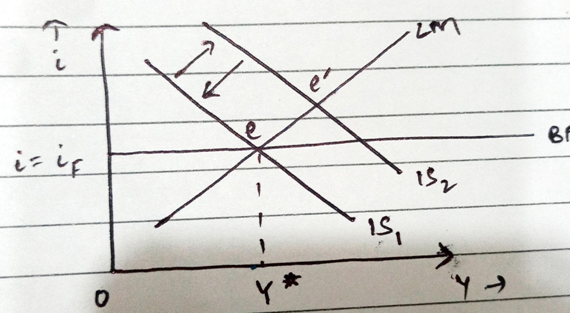
More Research Questions
- Based on the Economic Survey 2025-26, what was the status of Scheduled Commercial Banks' (SCBs) asset quality as of September 2025?
- For the following demand curve, Q=10P-1 , calculate the profit made by the monopolist when Total cost is Rs.2Q and he sells discrete goods i.e. 1,2,3 and s...
- Assume that there are equal numbers of male and female students in a university. Of all male students, 10 per cent major in economics; and of all female st...
- The inverse demand function for a commodity is P = 50-2Q-Q2 . Calculate the consumer surplus when quantity demanded is 5 unts.
- Which of the follow statements about price discrimination is not true?
- Whenrxy>0,thenbyxandbxyareboth:
- If a random variable X follows a uniform distribution between 0 and 1, what is the expected value of X?
- When exchange rate in terms of domestic currency rises
- According to the Union Budget 2025-26, which of the following is the central theme that aims to stimulate balanced growth across all regions of India?
- Knife edge problem is associated with the following growth models?
Hey! Ask a query
Please enter email id
The email must be a valid email address.
Please enter Mobile Number
Please enter valid Mobile Number
Please enter your Doubt

Think You're Ready for RBI Grade B?
RBI Grade B 2026 Phase 1 Memory Based Paper
- 200 Questions with Detailed Solutions
- Section-wise Coverage (GA, English, Quant & Reasoning)