
Question
Which of the following statement(s) about NBFCs is
incorrect? Read the following passage and answer the next 4 questions Reserve Bank of India has been regulating the financial activities of the Non-Banking Financial Companies under the provisions of Chapter III B of the Reserve Bank of India Act, 1934. With the amendment of the Reserve Bank of India Act, 1934 in January 1997, in terms of Section 45 IA of the said Act, and amendment of the National Housing Bank Act, 1987 in August 2019, in terms of Section 29 A of the National Housing Bank Act, 1987, all Non-Banking Financial Companies including Housing Finance Companies have to be mandatorily registered with the Reserve Bank of India. The credit-related matters of banks have been progressively deregulated by the Reserve Bank of India. Consistent with the policy of bestowing greater operational freedom to banks in the matter of credit dispensation and in the context of mandatory registration of NBFCs with the Reserve Bank, most of the aspects relating to the financing of NBFCs by banks have also been deregulatedSolution
· NBFCs cannot accept demand deposits but can only accept time deposits. Even for accepting time deposits (referred to as public deposits), the NBFC should have such registration as NBFC-deposit taking, from RBI and comply with the necessary requirements. · As per the recent Scale Based Regulation by RBI for NBFCs, NBFCs without public funds and customer interface will always remain in the Base Layer of the regulatory structure · The extant NPA classification norm stands changed to the overdue period of more than 90 days for all categories of NBFCs. A glide path is provided to NBFCs in Base Layer to adhere to the 90 days NPA norm as under – 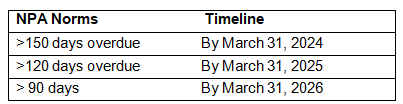 The glide path will not be applicable to NBFCs which are already required to follow the 90-day NPA norm. · There shall be a ceiling of Rs.1 crore per borrower for financing subscription to Initial Public Offer (IPO). NBFCs can fix more conservative limits. Please refer to the Circular RBI/2021-22/112 DOR.CRE.REC.No.60/03.10.001/2021-22 dated 12.10.2021 for more details (also refer to notes on NBFCs)
Stamped red-glazed pottery, known as Arrentine Ware, has been found in many ancient settlements of the South India. The 'Arrentine Ware' were named afte...
8 workers working for 8 days make 8 motor cycles. Then how many motor cycles would be made by 4 workers if they work for 4 days? Assume equal efficiency...

Study the adjoining picture and answer the following questio...
It is colder at the top of a mountain as compared to the base because
Who, in mythology, wished for everything he touched to turn to gold?
The Capital city of which amongst the following states of India is farthest from the Tropic of Cancer (23N) ?
The headquarter of RBI is situated at-
An Atoll is __________.
How many medals did India win in the London Olympics?
The Preamble to the Constitution of India was amended by the 42nd Amendment Act and inserted the following words in the existing Preamble:


