


Question
Consider the following statements about the reign of
King Ashoka: 1. He is the first Indian king to communicate directly to the people through his inscriptions. 2. Ashokan inscriptions are found only in India. 3. Along with Sanskrit, languages like Aramaic and Greek were also used on the inscriptions. Which of the statements given above is/are correct?Solution
The Edicts of Ashoka are a collection of more than thirty inscriptions on the pillars, as well as boulders and cave walls, attributed to Emperor Ashoka of the Mauryan Empire who ruled from 268 BCE to 232 BCE. • Ashoka inscriptions can be classified into three: o Pillar edicts, o Major rock edicts and o Minor rock edicts. • He is the first king to speak directly to people through his inscriptions. Hence, statement 1 is correct • They are not only found in Indian Subcontinent but also in places like Kandhar in Afghanistan. Hence, statement 2 is not correct • These are composed in Prakrit language (not sanskrit) in Brahmi script through out the greater part of the empire. Hence, statement 3 is not correct.
What was the main objective of the Firka Development Scheme initiated in Madras Presidency in 1946?
Yellow revolution represents the production of ........................?
Polymorphism in fungi was first observed by:
Which soil covers the largest area in India?
When agriculture is major component and trees are secondary, the system is called
Which of the following is propagated by stem cuttings and used extensively in bedding plant designs?
Chromosome number (n) of potato (Solanum tuberosum) is
Primary-Storage grain pest of pulses which infects in both the field and storage conditions?
Which of the following pair is NOT correctly matched?
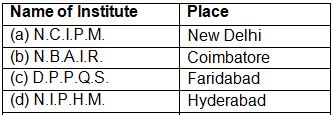
What is the primary purpose of the National Green Tribunal (NGT) in India?
Relevant for Exams:


