


Question
Two friends, E and F, started a business by investing RS 1,20,000 and RS 1,80,000, respectively. They agreed to distribute their earnings in the same ratio as their investments. After a year, the profit earned was RS 4,50,000. Each of them added RS 30,000 to their respective profits and invested in a different project. If this project yielded RS 3,40,000, then E’s share in the profit is.
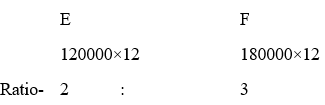 Total =2+3=5 5 = 450000 1=90000 E=2= 90000×2=180000 F=3=90000×3=270000 Add Each of them 30000.
 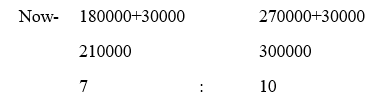 17 = 3,40,000 1= 20000 Profit part of E = 7×20000= 140000
 More Partnership Questions
- ‘M’ started a business with an investment of Rs. 5000. After 2 months ‘N’ joins the business with an investment of Rs. 2950. If the total profit earned by ...
- A, B and C invest in a partnership in the ratio 6:3:8 and investment of A is Rs.200 less than investment of C. Partner B invests for 1/5th and A and C inve...
- ‘A’ and ‘B’ started a business by investing Rs. 4000 and Rs. 8000, respectively. 8 months later, ‘C’ joined them with an investment equal to average of ini...
- The savings of Arun and Bhaskar are same. The difference between the expenditure of Bhaskar and the savings of both Arun and Bhaskar together is 0. The inc...
- P invested Rs. 20,000 in a SIP offering 10% compound interest compounded annually, whereas M invested Rs. 2000 more than the amount invested by P in a SIP ...
- Simran and Indu started a business investing Rs. 110, 000 and Rs. 80,000 respectively. In what ratio the profit earned after 2 years be divided between Sim...
- Ramesh, Rajan and Ritesh enter into partnership by making investments in the ratio 3 : 5 : 7. After a year, Ritesh invests another Rs. 337600 while Ramesh ...
- Manoj and Mahesh invested Rs. 6,000 and Rs. 9,000 respectively in a venture. Mahesh withdrew after a few months. At the end of the year, profit was divided...
- Shyam and Tarun invested Rs. 1800 and Rs. 2700 respectively in a business. After 6 months, Dinesh joined with Rs. ‘x’. If Shyam’s share from a total annual...
- A and B start a business by investing Rs 24,000 and Rs 36,000 respectively. After 4 months, C joins with an investment of Rs x. At the end of the year, the...
Hey! Ask a query
Please enter email id
The email must be a valid email address.
Please enter Mobile Number
Please enter valid Mobile Number
Please enter your Doubt

Think You're Ready for RBI Grade B?
RBI Grade B 2026 Phase 1 Memory Based Paper
- 200 Questions with Detailed Solutions
- Section-wise Coverage (GA, English, Quant & Reasoning)