


Question
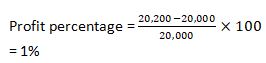
A trader purchased 100 identical items for a total of ₹20,000. He sold 40% of the items at a profit of 25% and the remaining items at a loss of 15%. Determine the overall profit or loss percentage for the entire transaction.
More Profit and loss Questions
- Among 120 sweets, 'p' sweets were sold for Rs. 5 each, while the remaining were sold for Rs. 'q' each. If Rs. 'pq' is added to the selling price of the (12...
- A shopkeeper marked his article 75% above the cost price and sold it after giving a single discount of 12%. If the shopkeeper earned a profit of Rs. 540 in...
- Two varieties of rice are mixed together – type 'P' costing Rs. 60/kg and type 'Q' costing Rs. 100/kg. The mixture is then sold for Rs. 126/kg, yielding a ...
- By giving a discount of 23% on the market price of an article, the trader earns a profit of 10%. If the difference between the market price and the cost pr...
- Rahul bought 25 notebooks for Rs. 200 and he sold them in such a manner so that selling price of 10 notebooks is Rs. 100. Find the value of 5(P + 5) if the...
- A shopkeeper marked an article P% above its cost price and sold it for Rs. 480 after giving a discount of 20%. If the ratio of cost price and selling price...
- A merchant sold four types of products P, Q, R, and S. He sold products P and Q in the ratio of 3:4, while he sold products R and P in the ratio of 7:3. Th...
- A person bought a mobile phone at a 10% discount. If he had bought it at a 20% discount, he would have saved ₹3000 more. Find the market price of the mobi...
- A shopkeeper marks an article 40% above its cost price and allows a discount of 15% on the marked price. If the cost price is Rs 2500, then the profit is:
- A sold an article at 45% profit. If the profit earned had been 228% more, then the profit percentage would have been numerically equal to CP. Find the actu...
Relevant for Exams:
Hey! Ask a query
Please enter email id
The email must be a valid email address.
Please enter Mobile Number
Please enter valid Mobile Number
Please enter your Doubt

Think You're Ready for RBI Grade B?
RBI Grade B 2026 Phase 1 Memory Based Paper
- 200 Questions with Detailed Solutions
- Section-wise Coverage (GA, English, Quant & Reasoning)