


Question
Quantity I : Number of days the work is extended beyond normal days. A can do a piece of work in 100 days and B in 60 days. Both of them start working together and 6 days before the scheduled completion, B drops out. Quantity II : Number of days required to complete the work working 10 hrs daily by 60 women working together. 24 men take 20 days working 12 hrs daily to do a piece of work, if 5 women do as much work as 4 men.
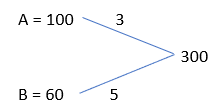 Both can complete the work in 300/8 = 37.5 days Work done in (37.5 – 6) days = 31.5 × 8 = 252 unit Remaining work = 300 – 252 = 48 unit After B drops out remaining part will be completed by A in = 48/3 = 16 days Total time taken = 31.5 + 16 = 47.5 days Actual time taken = 37.5 days Difference = 47.5 – 37.5 = 10 days Quantity II: 5W = 4M 1W = (4/5) M Let the no. of days required to complete the work is D. 10 × 60W × D = 24M × 20 × 12 10 × (60×4)/5 M × D = 24M × 20 × 12 D= 12 days Hence, Quantity I < Quantity II .
More Quantity Inequality Questions
- Quantity 1: A basket contains 30 apples, of which 20% are bad. If 15 more good apples are added, what is the total number of good apples in the basket now?...
- Quantity I: Akash is 50% more efficient than Ramesh and three times as efficient as Suresh. Suppose Ramesh and Suresh work together, they can complete the ...
- Quantity I: An amount is to be distributed among A, B, and C in the ratio 1:3:2 respectively, but was erroneously distributed in the ratio 2:7:9 due to whi...
- Quantity-I: The perimeter of a square is 64 cm. Find the side of the square. Quantity-II: The area of a rectangle is 150 cm², and its length is 25 cm. Fin...
- What is the profit percent or loss percent incurred in the transaction? Statement I: 5% discount is given on the marked price. Statement II: Cost price i...
- What is the larger number? Quantity I. Difference between the two numbers is 21 and LCM and HCF of those numbers are 70 and 7 respectively. Quantity II. Th...
- A alone can complete the work in 36 days. B’s efficiency is double that of A, and C’s efficiency is half of B’s efficiency. A and B start the work together...
- Quantity I: A vessel contains a mixture of milk and water in the ratio of 7 : 5. If 9 litre of mixture is sold and replaced by same amount of water then th...
- In the question, two Quantities I and II are given. You have to solve both the Quantity to establish the correct relation between Quantity-I and Quantity-I...
- Quantity-I: 'Arjun' and 'Bheem' are running on a circular track with a diameter of 'a' meters, at speeds of 25 m/s and 40 m/s, respectively. If they are mo...
Relevant for Exams:
Hey! Ask a query
Please enter email id
The email must be a valid email address.
Please enter Mobile Number
Please enter valid Mobile Number
Please enter your Doubt

Think You're Ready for RBI Grade B?
RBI Grade B 2026 Phase 1 Memory Based Paper
- 200 Questions with Detailed Solutions
- Section-wise Coverage (GA, English, Quant & Reasoning)