
Question
Hemant invested Rs. ‘y’ at the rate of (r+2)% per
annum on simple interest and after four years Rs. 27520 was obtained as an interest. If Rs. (y+2500) was invested at the rate of ‘r’% per annum compounded annually and after two years Rs. 16560 was obtained as an interest, then find out the value of ‘r’.Solution
Hemant invested Rs. ‘y’ at the rate of (r+2)% per annum on simple interest and after four years Rs. 27520 was obtained as an interest.
y x (r+2)% x 4 = 27520
y x (r+2) x 4 = 2752000
y x (r+2) = 688000
y = 688000/(r+2) Eq.(i)
If Rs. (y+2500) was invested at the rate of ‘r’% per annum compounded annually and after two years Rs. 16560 was obtained as an interest.
(y+2500)[{(100+r)/100}^2 - 1] = 16560
Put Eq.(i) in the above equation.
(688000/(r+2)+2500)[{(100+r)/100}^2 - 1] = 16560
5r^3+2386r^2−54000r−662400=0
(r−30) (5r^2+2536r+22080)=0
There are three values of ‘r’. But two of them are negative and not possible.
So the value of ‘r’ = 30.
Calculate: 0.75 × 0.4 + 2.5 ÷ 0.5 − 0.36
2.666 …+ 2.77… in fraction form is:

If log₁₀(x + 3) − log₁₀(x − 1) = 1, find the value of x.
Simplify: 3/4 + 0.6 − (1/5 × 1.5)
There is a fraction whose denominator is 5 more than its numerator. If the numerator is increased by 10 and denominator is decreased by 4, the fraction ...
Express 0.045 as a fraction in simplest form.
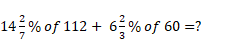
A complex fraction evolves into 25/21 when 25% of the numerator is added to the numerator, and simultaneously, 23% of the denominator is subtracted from...
The top part (numerator) of a fraction is 4 more than three times the bottom part (denominator). If we reduce the numerator by 15 and increase the denom...


