
Question
A man takes 200 days to finish a work alone. If he
started working alone and joined by one more man having same efficiency as of him every day from 2nd day onwards, then find the time taken to finish the same work this way.Solution
ATQ, Let the total work be 200x units Efficiency of each man = (200x / 200) = x units/day Total time taken = {n × (n + 1)} ÷ 2 = 200 So, n × (n + 1) = 400 Or, n² + n = 400 Or, n² + n – 400 = 0 Or, n² + 21n – 20n – 400 = 0 Or, n(n + 21) – 20(n + 21) = 0 Or, (n – 20)(n + 21) = 0 So, n = 20 Number of days required to finish the work = 20
If x and y are two random variables and a, b, c, d are any numbers provided a ≠ 0, c ≠ 0, then correlation co-efficient between ax + b and cy + d is...
A statistician collects data on production of rice from 1990 to 20 2 0 and classifies it year wise. Which of the following type of classification of da...
Suppose for estimating y, the equation Ŷ= 5 – 2x calculations are made on a given set of data, which of the following is true for this situation?
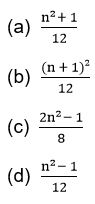
The variance of first n natural numbers is -
Which of the following methods to measure seasonal variations comparatively utilizes the given data less?
Which of the following statement is not true?
If the salary of a person in the base year is Rs. 2000 per annuli and in the current year Rs. 5000. The CPI is 325, then the allowance required to maint...
Which of the following is not a cause of rightward shift of demand curve?
For discrete distribution, the co-efficient of kurtosis β₂ is -
Which of the following statement is true for NRR?
Relevant for Exams:


