
Question
Train B whose length is (l+40) metre can cross a pole in
20 seconds. Train A can cross 168 metre long platform in 44 seconds. The length of train A is 80 metre less than that of train B. If the speed of train A is 10 m/s less than that of train B, then find out the value of ‘l’.Solution
If the speed of train A is 10 m/s less than that of train B. Let’s assume the speed of train A is ‘y’ m/s. y = (speed of train B) - 10 speed of train B = (y+10) m/s Train B whose length is (l+40) metre can cross a pole in 20 seconds. (y+10) = (l+40)/20 20(y+10) = (l+40) 20y+200 = (l+40) 20y = (l+40)-200 20y = (l-160) y = (l-160)/20 Eq.(i) The length of train A is 80 metre less than that of train B. length of train A = (l+40)-80 = (l-40) metre Train A can cross 168 metre long platform in 44 seconds. [(l-40)+168]/44 = y Eq.(ii) Eq.(i) = Eq.(ii) (l-160)/20 = [(l-40)+168]/44 (l-160)/5 = [(l-40)+168]/11 11l-1760 = 5l-200+840 11l-1760 = 5l+640 11l-5l = 640+1760 6l = 2400 Value of ‘l’ = 400
Which of the following is NOT a bacterial disease?
Which vitamin is often referred to as the 'beauty vitamin'?
Animals that lack a body cavity are known as __________.
Urine is produced in ______.
__________results in the formation of zygote.
Respiration occurs in which part of the cell?
Match List-I with List-II :
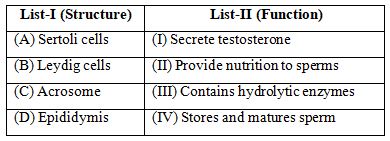
Which of the following is a symptom of protein-energy malnutrition (PEM)?
How many molecules of ATP are released from one glucose molecule during anaerobic respiration?
Which of the following is the smallest known flowering plant?


