
Question
Statements: B > C= D > F < G = J; H > F > I ≥ E
Conclusions: I. C > E II. H < G III. J = H In the following question assuming the given statements to be true, find which conclusion (s) among given three conclusions is/are definitely true and then give your answer accordingly.Solution
C = D > F > I ≥ E C > E. Hence conclusion I is true. H > F < G No relationship can be established between G and H. Hence conclusion II is not true. H > F < G = J No relationship can be established between J and H. Hence conclusion III is not true.
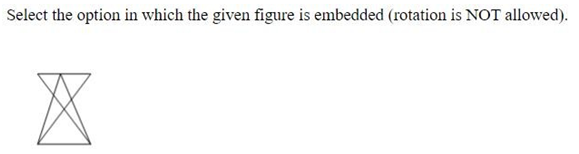
Select the option that is embedded in the given figure: (Rotation is not allowed).

Find out which of the figures (1), (2), (3) and (4) can be formed from the pieces given in figure (X) .
From the given answer figures, select the one in which the question figures is hidden.
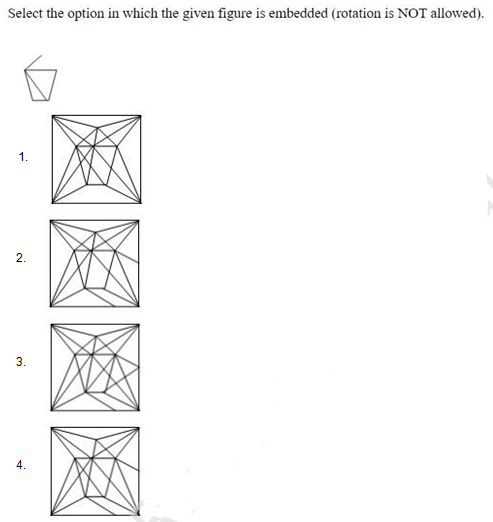
Find out the alternative figure which contains the given figure as its part.
Select the option which is embedded in the given figure (rotation is not allowed).
Find out the alternative figure which contains figure (X) as its part.
Select the option figure which is embedded in the given figure. (Rotation is not allowed).
Select the option in which the given figure is embedded (rotation is not allowed) .
Relevant for Exams:


