


Question
How many people are standing between G and D in a straight line of 15 people (Note: All are standing in a straight line facing north.)?
How many people are standing between G and D in a straight line of 15 people (Note: All are standing in a straight line facing north.)?
I. F stands fifth from the left end of the line. G and E are immediate neighbours of F. Only two people stand between F and
D.
II. H stands third from the right end of the line. Only six people stand between E and H. Only one person stands between G and E. E stands exactly between G and
D.
Each of the questions below consists of a question and two statements numbered I and II given below it. You have to decide whether the data provided in the statements are sufficient to answer the question. Read both the statements and Give answer :
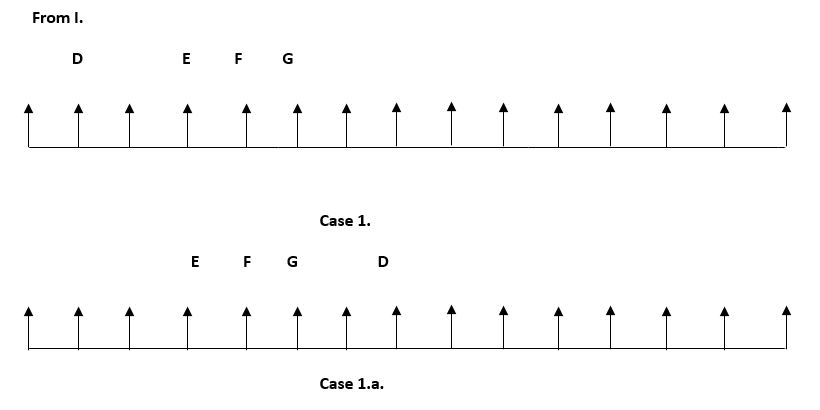 Hence statement I alone is not sufficient to answer the question.
 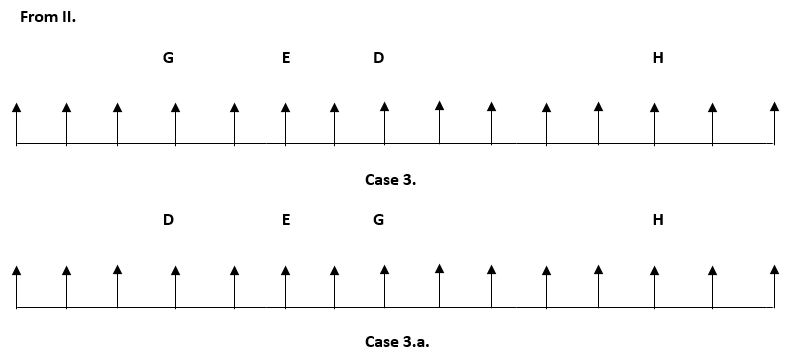 Three people are standing between G and D. Hence Hence statement II alone is sufficient to answer the question.
More Reasoning Miscellaneous Questions
- If the consonants of the following words are arranged first, followed by the vowels as per the English alphabetical order and then the consonants are chang...
- Consider the symbols '*, $, #, @, %' and the various meanings associated with them asfollows: 'A * B' means ' A is not greater than B' 'A $ B' means 'A is ...
- Four letter-clusters are given out of which three are alike in some manner and one is different. Select the odd-one out.
- Which of the following is used to transfer data between computers over the Internet securely?
- Which of the following is NOT a function of BIOS?
- Based on the scenario given, choose the decision from the options which would be most suitable. For a first time offence by an employee at the factory, th...
- Statements: P > Q < R = U ≤ V = S ≤ W ≥ X > I Conclusions: I. Q ≥ V II. R ≤ W
- 1. Walls 2. Floor 3. Roof 4. Room 5. Foundation 6. Window
- If all the vowels in the word ‘BECAUSE’ are changed to the next letter in the English alphabetical order and all the consonants remain the same then all th...
- ‘X’ and ‘Y’ invested Rs. 6000 and Rs. 7500 respectively for 10 months and 8 months respectively in a business. X gave away 60% of his profit to a welfare f...
Hey! Ask a query
Please enter email id
The email must be a valid email address.
Please enter Mobile Number
Please enter valid Mobile Number
Please enter your Doubt

Think You're Ready for RBI Grade B?
RBI Grade B 2026 Phase 1 Memory Based Paper
- 200 Questions with Detailed Solutions
- Section-wise Coverage (GA, English, Quant & Reasoning)