


Question
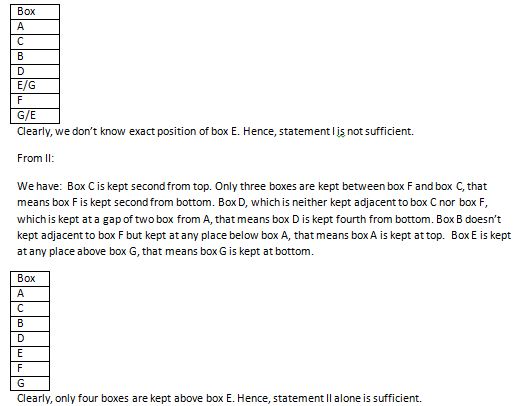
Seven boxes viz. A, B, C, D, E, F and G are kept one above other in the form of stack. How many boxes are kept above box E?
Seven boxes viz. A, B, C, D, E, F and G are kept one above other in the form of stack. How many boxes are kept above box E?
I. Only two boxes are kept between box B and box F. Only three boxes are kept above box
D. Box B and D are kept together. Only one box is kept between box E and box G. Box A is neither kept at bottom nor adjacent to box
B.
II. Box C is kept second from top. Box E is kept at any place above box G. Only three boxes are kept between box F and box
C. Box D, which is neither kept adjacent to box C nor box F, which is kept at a gap of two box from
A. Box B doesn’t kept adjacent to box F but kept at any place below box
A.
Each of the questions below consists of a question and three statements numbered I, II given below it. You have to decide whether the data provided in the statements are sufficient to answer the question:
More Data Sufficiency Questions
- Eight persons K, L , M, N, O, P, Q and R are seated around a circular table facing the centre. Who is opposite P? I. P sits second to the left of N, who i...
- In this question, a question is followed by two statements numbered (I) and (II). You have to decide whether the data provided in the statements are suffic...
- The question given below consists of two statements numbered I and II given below it. You have to decide whether the data provided in the statements are su...
- The question given below consists of two statements numbered I and II given below it. You have to decide whether the data provided in the statements are su...
- Six persons D, E, F, G, H, and I have different heights. Who is the tallest person? Statement I: F is shorter than D. G is taller than I but shorter than F...
- What is Guna's age? I. Guna, Vinay and Keshav are all of the same age. II. Sum of ages of Vinay, Keshav and Arjun is 32; also, Arjun is as old as Vinay ...
- Seven person namely – G, H, I, J, K, L and M have different height. How many person are taller to J? Statement I: J is taller to K, H but not as much as G,...
- How is ‘dog’ coded in a code language? I. ‘loyal and intelligent dog’ is coded as ‘la po hi do’ II. ‘dog is running fast’ is coded as ‘po ro no ji’
- Six persons L, M, N, O, P and Q live on a 6 storey building. The bottommost floor is numbered 1 and the topmost floor is numbered 6. Who lives immediately ...
- How is LETTER written in the code language? I. MASTER is written as NZHGVI II. BOTTLE is written as YLGGOV
Relevant for Exams:
Hey! Ask a query
Please enter email id
The email must be a valid email address.
Please enter Mobile Number
Please enter valid Mobile Number
Please enter your Doubt

Think You're Ready for RBI Grade B?
RBI Grade B 2026 Phase 1 Memory Based Paper
- 200 Questions with Detailed Solutions
- Section-wise Coverage (GA, English, Quant & Reasoning)