


Question
A, B, C, D , E and F are sitting around a circular table facing the center. Who sits in front of C?
A, B, C, D , E and F are sitting around a circular table facing the center. Who sits in front of C?
I.A sits second to the right of F, who is second to the right of C, who is not the neighbour of
B.
II. B is second to the left of D, who is third of the left of F. C is not the neighbour of
D.
Each of the questions below consists of a question and two statements numbered I and II given below it. You have to decide whether the data provided in the statements are sufficient to answer the question. Choose your answer from the options based on this.
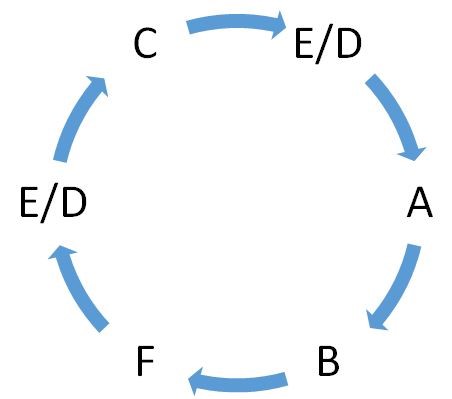 Thus B sits in front of C. From II.
 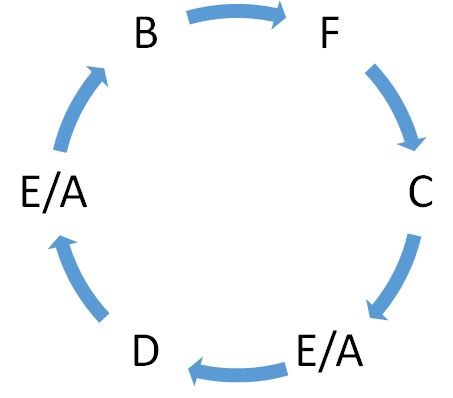 Thus either A or E sits in front of C. Hence, only statement I is sufficient to answer the question.
More Data Sufficiency Questions
- How many children does Mr. Jagdish has? I. Mr. Jagdish has six sons and each has one sister. II. Number of sons of Mr. Jagdish is six times the number of h...
- The question below consists of two statements 1 and 2. Decide whether the facts provided in the statements are sufficient to answer the question. Questio...
- Eight persons, P, Q, R, S, T, U, V and W are sitting in a row. All of them are facing the north. Who is sitting at the extreme left end? Statements: I. Thr...
- Five persons P, Q, R, S, and T live on five different floors. The bottom floor is numbered 1 and the top floor is numbered 5. Also, each of them was born i...
- A question is given, followed by two statements numbered (I) and (II). You have to decide whether the data provided in the statements is sufficient to answ...
- Z is in which direction with respect to R? I. Q is 4 km towards north of R. S is 8 km towards west of Q. Z is 4 km towards north of Q. II. Z is 8 km to...
- Statements: K ≤ L, L = M, M < N Conclusion: I. N > L II. M ≥ K
- Among six friends S, T, U, V,W and X, who gets the second highest marks? I. X gets more marks than U and W but not as much as T. V gets more marks than W ...
- How many persons are standing in a line, if all of them are facing south? Some person are standing in a straight line. I Only one person is standing to the...
- The question given below consists of two statements numbered I and II given below it. Read all the statements and give answer. Seven persons N, O, P, Q, ...
Hey! Ask a query
Please enter email id
The email must be a valid email address.
Please enter Mobile Number
Please enter valid Mobile Number
Please enter your Doubt

Think You're Ready for RBI Grade B?
RBI Grade B 2026 Phase 1 Memory Based Paper
- 200 Questions with Detailed Solutions
- Section-wise Coverage (GA, English, Quant & Reasoning)