


Question
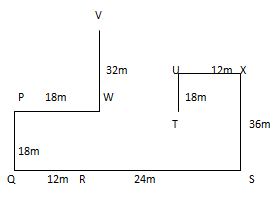
What is the position of R with respect to T?
More Direction and Distance Questions
- Savita starts walking from Mall and walks 10 m towards East and then turns right and walks 90 m. Then she turns left and walks 40 m. After that she again t...
- In which direction point M with respect to point K?
- What is the shortest distance between J and N?
- Pole A is 4m to the west of pole R. Pole S is 8m to the north of pole A. Pole C is 6m to the north of pole B, which is 4m to the west of pole S. In which d...
- E @ F % G # H @ I, then in which direction is I with respect to F?
- If C is 4m to the south of Q, then find the distance between V and C?
- Shyam walks 10m north from his house, turns left and walks 25m, again turn right and walks 40m, then turns left and walks 5m to reach the school. In which ...
- What is the shortest distance between point R and the point, which is 2m north of point P?
- If a person walks 8m towards North from point E and turns right and walks 1m, then that will be between which of the points and how far will he be from poi...
- P is in which direction with respect to D.
Hey! Ask a query
Please enter email id
The email must be a valid email address.
Please enter Mobile Number
Please enter valid Mobile Number
Please enter your Doubt

Think You're Ready for RBI Grade B?
RBI Grade B 2026 Phase 1 Memory Based Paper
- 200 Questions with Detailed Solutions
- Section-wise Coverage (GA, English, Quant & Reasoning)