


Question
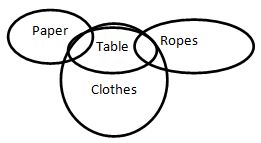
Read the given statements and conclusions carefully. Assuming that the information given in the statements is true, even if it appears to be at variance with commonly known facts, decide which of the given conclusions logically follow(s) from the statements. Statements: Some papers are tables. Some ropes are tables All tables are clothes. Conclusions: (
- I Some papers are clothes. (I
- I Some ropes are clothes. (II
- I No cloth is a rope. (I
- V No paper is a rope.
More Previous year papers Questions
- Seven boys J, K, L, M, N, P and Q are sitting around a circular table facing towards the centre (not necessarily in the same order). P is second to the r...
- O, P, Q, R, S, T, and U are seven boxes that are kept one over the other but not necessarily in the same order. Only one box is kept between R and P. Only ...
- There is a group of 6 people: A, B, C, D, E and F (not necessarily in the same order). D is taller than A and E. F is taller than B and C. E is taller than...
- A bank in to the east of a shop. A college is to the north-west of the Bank. A bus stop is to the north of the shop and to the west of the college. In whic...
- If the given sheet is folded to form a cube, which of the following figures is NOT possible?
- Select the option that is related to the third word in the same way as the second word is related to the first word. Lazy : Hard-working : : Wealthy : ?
- An Assertion (A) and a Reason (R) are given below. Assertion (A): The Indian Constitution came into force with effect from 26th January 1950. Reason (R): ...
- Which two signs should be interchanged to make the given equation correct? 729 × 9 – (56 – 6) × 5 ÷ 2 + 152 × 19 = 69
- In a certain code language, 'FOXES' is written as '138' and 'TIMED' is written as '102'. How will 'FOUND' be written in that code language?
- From the given option figures, select the one in which the question figure is hidden/embedded. (Rotation is NOT allowed)
Hey! Ask a query
Please enter email id
The email must be a valid email address.
Please enter Mobile Number
Please enter valid Mobile Number
Please enter your Doubt

Think You're Ready for RBI Grade B?
RBI Grade B 2026 Phase 1 Memory Based Paper
- 200 Questions with Detailed Solutions
- Section-wise Coverage (GA, English, Quant & Reasoning)