


Question
Which of the following box is kept just above box B?
Answer the questions based on the information given below. Eight boxes viz. A, B, C, W, X, Y, Z and Q are placed one above the other in the single stack, but not necessarily in the same order. The lowermost box is numbered 1 and the box above is numbered 2 and so on. The consecutive alphabetically named boxes were not placed adjacent to each other. Three boxes are placed between Q and Z where neither of them is placed at the top and bottommost position. Two boxes are placed between Y and C where box C is placed immediately below box Q. Box A is placed immediately above box
X.At least three boxes are there between B and W which is not placed at the bottommost position.
X.At least three boxes are there between B and W which is not placed at the bottommost position.
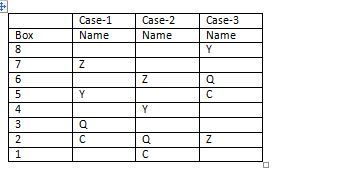 2) Box A is placed immediately above box X. At least three boxes are there between B and W which is not placed at the bottommost position. Hence, cases 1 and 2 get eliminated.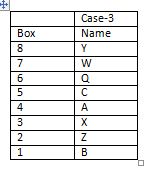
More Puzzles Questions
- Which of the following does not belong to the group?
- Which of the following plants was exhibited on Thursday?
- Which of the following combinations is true with respect to the given arrangement?
- What is the position of Y from the top of the building?
- Who among the following lives two floors above the floor on which B lives in the same flat?
- Which of the following box is placed immediately above Box E, on the same stack?
- On which floor does the person live who likes Shreya ghoshal?
- Which of the following is true regarding Ashwani?
- Who among the following person participates on August 17?
- How many persons likes after the one who likes Papaya?
Relevant for Exams:
Hey! Ask a query
Please enter email id
The email must be a valid email address.
Please enter Mobile Number
Please enter valid Mobile Number
Please enter your Doubt

Think You're Ready for RBI Grade B?
RBI Grade B 2026 Phase 1 Memory Based Paper
- 200 Questions with Detailed Solutions
- Section-wise Coverage (GA, English, Quant & Reasoning)