
Question
As many persons live between C and I is the same as the
number of person lives between G and ___? Study the following information carefully and answer the below questions. Nine persons- A, B, C, D, E, F, G, H, and I are living in nine-storey building such that the bottommost floor is numbered as one and immediately above it is numbered as two and so on till the topmost floor is numbered as nine. A lives four floors below C, either of them lives on the topmost floor or bottommost floor. Only two floors are there between A and B. The number of floors between C and B is the same as the number of floors between G and D. B lives immediately above D. E lives three floors above H who lives on an even number floor. The number of floors between H and D is the same as the number of floors between I and F. F and E does not live on the adjacent floors.Solution
We have, A lives four floors below C, either of them lives on the topmost floor or bottommost floor. Only two floors are there between A and B. From the above condition, there are three possibilities. 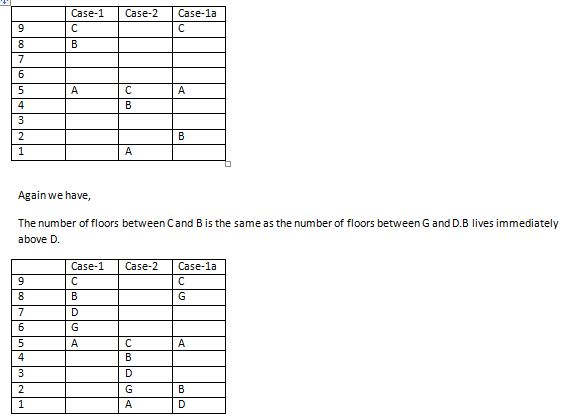 Again we have, E lives three floors above H who lives on an even number floor. The number of floors between H and D is the same as the number of floors between I and F. F and E does not live on the adjacent floor. From the above condition, case-1 and case-2 get eliminated. Case-1a shows the final arrangement.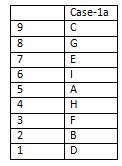
In a right angle triangle, the product of two sides is half of the square of the third side (i.e., hypotenuse). Accordingly find out the acute angle?
In the given Figure, Find angle BCD. If AB is a diameter & AB is parallel to CD.
In ΔABC, PQ is parallel to BC If AP: PB= 3:4 and AQ= 6 cm, AC is equal to?
In a line PQ, is drawn parallel to BC, points P, Q being on AB and AC respectively. If AB = 3 AP, then what is the ratio of the area of t...

If G is the centroid and AD, BE, CF are three medians of ∆ABC with area 42 cm 2 , then the area of ∆BGD is?
AB is parallel to DC in a trapezium ABCD. It is given that AB > DC and the diagonals AC and BD intersect at O. If AO=3x-15, OB = x +9, OC =x-5 and OD = ...
PQ and PR are the two chords of a circle. The tangents at Q and R meet at A. If ∠QPR = 64°, then the measure of ∠QAR is?
Two angles are complementary. The larger angle is 6° less than thrice the measure of the smaller angle. What is the measure of the larger angle?
Relevant for Exams:


