


Question
How many projects were completed by the person who lives on the floor number 5?
Study the following information carefully and answer the questions below. Seven boys students- W, Y, Z, M, N, O and J of a college worked on some number of assignments (project + Theory) for chemistry with the help of their girls friends viz. K, L, Q, T, G, P and R but not necessarily in the same order. All of them live in a seven storey apartment. First floor is numbered one and second floor is numbered two and so on till the topmost floor. Each boy has exactly one girl friend. Note:
I. If the student lives on an odd numbered floor, then he completed even numbers of theory work and odd numbers of projects.
II. If the student lives on an even numbered floor, then he completed odd number of theory work and even number of Projects.
III. Number of Theory work and Projects together is Assignment. Total number of theory done by all the students is two hundred and seven. Friend of Q completed an even number of projects. Only one person lives between friend of Q and the student who completed seventy nine assignments (project + Theory). Z lives immediately above the student who completed seventy nine assignments (project + Theory). Two students live between Z and friend of P. Friend of G completed an odd number of theory works. N completed twenty four theory works and doesn’t live on top and ground floor. Friend of K completed forty seven projects. J is the friend of R who lives on the first floor. W completed sixteen theory works. Total number of assignments (project + theory) completed by Y is k multiple of 9 as well as 11, but he is not the friend of Q. The theory work completed by the student who lives on third floor is six more than that of by the student who lives on fifth floor. G completed 10 more projects than Z’s theory work. Total assignments completed by W is not sixty three. Total assignments (project + theory) completed by O is sixty seven. Total assignments completed by friend of R is twenty five and it is k sum of consecutive numbers. Total assignment (project + theory) completed by friend of L is forty five, but the number of projects completed by L is greater than the number of theories completed. Total assignments (project + theory) completed by friend of T is two more than the total assignments (project + theory) completed by
M. Friend of P completed 10 theories more than the friend of G. Friend of Q doesn’t live immediately below the person who completed forty seven projects. Total number of projects completed by all the students is two hundred and sixty six. Friend of Q does not live on second floor. Z is the friend of K. Y doesn’t lives on the second floor.
I. If the student lives on an odd numbered floor, then he completed even numbers of theory work and odd numbers of projects.
II. If the student lives on an even numbered floor, then he completed odd number of theory work and even number of Projects.
III. Number of Theory work and Projects together is Assignment. Total number of theory done by all the students is two hundred and seven. Friend of Q completed an even number of projects. Only one person lives between friend of Q and the student who completed seventy nine assignments (project + Theory). Z lives immediately above the student who completed seventy nine assignments (project + Theory). Two students live between Z and friend of P. Friend of G completed an odd number of theory works. N completed twenty four theory works and doesn’t live on top and ground floor. Friend of K completed forty seven projects. J is the friend of R who lives on the first floor. W completed sixteen theory works. Total number of assignments (project + theory) completed by Y is k multiple of 9 as well as 11, but he is not the friend of Q. The theory work completed by the student who lives on third floor is six more than that of by the student who lives on fifth floor. G completed 10 more projects than Z’s theory work. Total assignments completed by W is not sixty three. Total assignments (project + theory) completed by O is sixty seven. Total assignments completed by friend of R is twenty five and it is k sum of consecutive numbers. Total assignment (project + theory) completed by friend of L is forty five, but the number of projects completed by L is greater than the number of theories completed. Total assignments (project + theory) completed by friend of T is two more than the total assignments (project + theory) completed by
M. Friend of P completed 10 theories more than the friend of G. Friend of Q doesn’t live immediately below the person who completed forty seven projects. Total number of projects completed by all the students is two hundred and sixty six. Friend of Q does not live on second floor. Z is the friend of K. Y doesn’t lives on the second floor.
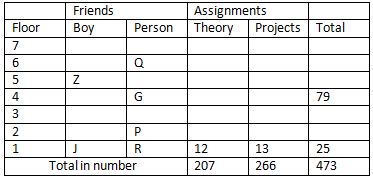
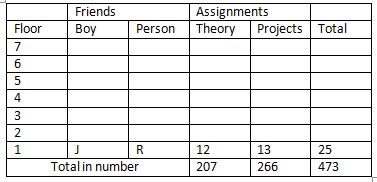 Friend of Q completed an even number of projects. Friend of G completed an odd number of Theory works. Friend of P completed 10 theory works more than the friend of G. Only one student lives between Friend of Q and the student who completed seventy nine assignments (project + Theory). Z lives immediately above the student who completed seventy nine assignments (project + Theory). Two students live between Z and friend of P. Friend of Q does not live on second floor. Case-1
 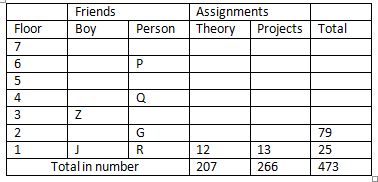 case-2
  N completed twenty four theory works and neither lives on the top nor on the lowest floor. W completed sixteen theory work. Z is the friend of K Friend of K completed forty seven projects. Friend of Q doesn’t live immediately below the person who completed forty seven projects. Case-1
 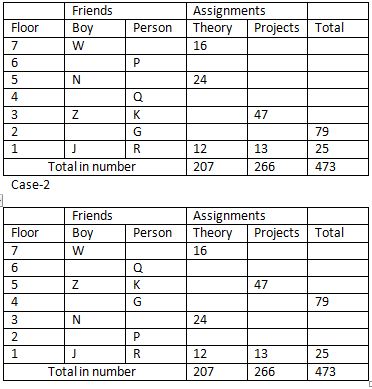 Total assignments (project + theory) completed by friend of L is forty five, but number of projects completed by L is greater than number of theories completed. Total number of assignments (project + theory) completed by Y is k multiple of 9 as well as 11, but he is not the friend of Q. The theory work completed by the student who lives on third floor is six more than that of by the student who lives on fifth floor. G completed 10 more projects than Z’s theory work. Friend of P completed 10 theories more than the friend of G. Y doesn’t lives on the second floor. So case 2 will be eliminated and we get final arrangement: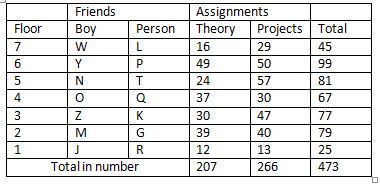
More Puzzles Questions
- Who among the following person lives three floors above Q?
- Study the information and answer the given questions: Eight persons live on different floors in the same building. The building has eight floors ground ...
- Which of the following combination is true?
- Six boxes D, E, F, G, H and I are kept one above another. The bottommost box is numbered as 1 and the topmost box is numbered as 6. D is three boxes below ...
- Who among the following person stands third to the right of N?
- Who among the following belongs to Uttar pradesh?
- The student who belongs to China appeared for which exam?
- Which of the following statement is/are not true?
- Which of the following group of employees work in IT department?
- Who live on the fourth floor of flat 2?
Hey! Ask a query
Please enter email id
The email must be a valid email address.
Please enter Mobile Number
Please enter valid Mobile Number
Please enter your Doubt

Think You're Ready for RBI Grade B?
RBI Grade B 2026 Phase 1 Memory Based Paper
- 200 Questions with Detailed Solutions
- Section-wise Coverage (GA, English, Quant & Reasoning)