Question
Who among the following lives on an even numbered
floor? Answer the questions based on the information given below. Ten persons namely, M, N, O, P, Q, R, S, T, U and V live in a building of five floors in Silicon Valley Society in Bangalore. The ground floor is considered as 1st floor, the floor above it as 2nd floor and so on. Each floor consists of two types of flats i.e. Flat-A and Flat-B. On every floor, Flat A is in the west of Flat-B. The dimensions of each of the flats are same. Only one person lives in each flat. U lives on 2nd floor. R lives two floors above S such that they both live in either Flat-A or Flat-B of their floors. Q lives in the west of O on an odd numbered floor. V, who lives in the same type of flat as that of Q, lives either three floors below or above M in the same type of flat as that of M. N and O live in the same type of flats such that N lives two floors above O. T lives neither on the topmost floor nor to the east of M.Solution
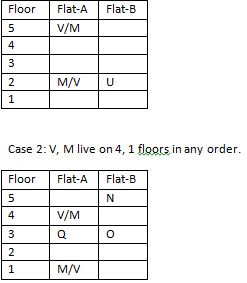
Q lives in the west of O on an odd numbered floor. Â V, who lives in the same type of flat as that of Q, lives either three floors below or above M in the same type of flat as that of M. It implies that Q, V, M live in flat-A of their floors while N, O live in flat-B of their floors. . R lives two floors above S such that they both live in either Flat-A or Flat-B of their floors. The next point is that V and M have two floors in between them and Q lives on an odd numbered floor. So, if we start placing Q, V, M, we can never place R and S who are two floors apart from each other in flat-A of their floors. So, it clearly means that R, S live in Flat-B. Thus, we finally get two cases: Case 1: V, M live on 5, 2 floors in any order. And U lives on 2nd floor. Now, if we see the first case R and V by placing N and O on odd numbered floors.U lives on 2nd floor , we will never be able to place U on 2nd floor.So, the first case gets rejected. We are left with Case 2 only. Case 2: Thus, U lives in flat-A on 2nd floor.
Simple interest received at the rate of 12% p.a. for 10 years on a principal amount of Rs. 3600 is twice of the simple interest received at 10% p.a. for...
A certain sum amounts to ₹13200 after 4 years and to ₹16400 after 8 years at the same rate per cent p.a. at simple interest. The simple interest (in...
A sum of ₹12,000 is invested at 8% per annum simple interest for 3 years. What will be the interest  earned?
Rajan invested Rs. 18,000 in a scheme offering x% p.a. simple interest for x years. Interest earned by him after ‘x’ years is Rs. 11520. Find the in...
A sum of Rs. (5x + 500) at 15% per annum earns Rs. 4500 over 6 years. Find the interest earned when Rs. (7x + 200) is invested at the same rate for the ...
- Calculate the compound interest earned on Rs. 18,000 when it is invested at 10% per annum, compounded semi-annually for 1 year.
A certain sum when invested at compound interest of 8% p.a. amounts to Rs. 5832 in 2 years. Find the amount received when the same sum is invested at 12...
- A total of Rs. 17400 is shared between 'X' and 'Y' in the ratio 11:7. If 'Y' invests his portion in a compound interest scheme at a rate of 10% per annum, ...
Anjali invested Rs.12000 in a scheme offering compound interest of x% p.a. compounded annually. If at the end of 2 years, interest received by her from ...
A sum of money at a specific annual simple interest rate grows to Rs. 2900 in 3 years and Rs. 3500 in 5 years. Calculate the inte...
