


Question
Which of the following combination is true?
Study the following information carefully and answer the questions given below it. Seven persons namely – A, B, C, D, E, F and G visits different place viz. Udaipur, Raipur, Jaipur, Rampur, Kanpur, Rudrapur and Bilaspur from Monday to Sunday. Each of them has different colour viz. Red, White, BLACK, Yellow, Pink, Green and Blue. All the above given information is not necessary in same order. There were three days gap between the one who has Pink and the one who visits Bilaspur. The one, who visits Udaipur, visits on any day after Friday. There were two days gap between the one, who have Yellow and F who visits Udaipur. There were three days gap between D and the one who visits Jaipur. One person visits between the one who visits Bilaspur and C, who has Red. The one, who visits Kanpur, visits on adjacent day of the one who has Green. At least three person visits between the one, who visits Rampur and the one, who has Blue. There were two days gap between G and the one who likes White, who visits on adjacent day of the one who has Yellow. C neither visits on adjacent day of the one has Yellow nor on adjacent day of F. A visits Raipur on Tuesday. G neither has Pink nor visits before the one who visits Kanpur and he visits Rudrapur. D and the one who has BLACK, visits the cities on adjacent days. Neither D nor B visits Jaipur. There were two days gap between A and the one who has Green.
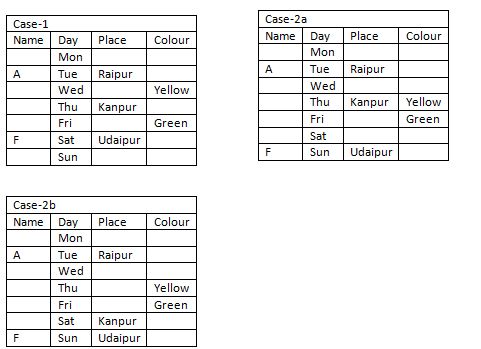 Again, we have: C neither visits on adjacent day of the one has Yellow nor on adjacent day of F. One person visits between the one who visits Bilaspur and C, who has Red, that means C visits on Monday. There were three days gap between the one who has Pink and the one who visits Bilaspur. G neither has Pink nor he visits before the one who visits Kanpur and he visits Rudrapur. There were two days gap between G and the one who likes White, who visits on adjacent day of the one who has Yellow, that means case (2b) is not valid, in case (1) G visits on Friday, in case (2a) G visits on Saturday.
 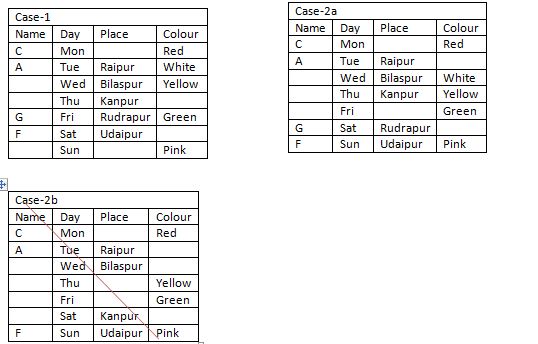 Case (2b) is not valid as G doesn’t visit before the one who visits Kanpur. Again, we have: The one who has BLACK and D visits on adjacent days. There were three days gap between D and the one who visits Jaipur, that means in case (1) D visits on Wednesday, in case (2) D visits on Friday. Neither D nor B visits Jaipur, that means in case (1) B visits Kanpur. At least three person visits between the one, who visits Rampur and the one, who has Blue, that means case (2a) is not valid. Based on above given information we have final arrangement we have: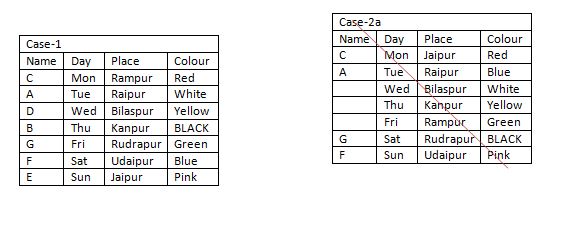
More Puzzles Questions
- Which of the following statement is/are true? I) Only three boxes are kept between V and U II) Box Q has kept immediately above Box T III) Box U and B...
- Seven boxes T, U, V, W, X, Y and Z are kept one above another such that bottommost box is numbered as 1 and topmost box is numbered as 7. At least four box...
- What is the Ice-cream flavor combination choice of those who are working in Bharti Airtel?
- Seven persons, Shikha, Garima, Nidhi, Pooja, Manisha, Neena and Anu, lives in a 7-storey building, but not necessarily in the same order. The bottommost fl...
- On which of the following floor number does ARUN get in?
- How many candidates take exam between the exam of A and N?
- In which floor and flat does S live?
- Which of the following statements is/are false regarding D?
- How many persons are having costlier bike than R?
- Jatin takes leave on which day?
Relevant for Exams:
Hey! Ask a query
Please enter email id
The email must be a valid email address.
Please enter Mobile Number
Please enter valid Mobile Number
Please enter your Doubt

Think You're Ready for RBI Grade B?
RBI Grade B 2026 Phase 1 Memory Based Paper
- 200 Questions with Detailed Solutions
- Section-wise Coverage (GA, English, Quant & Reasoning)