


Question
Who likes Daisy?
Study the following information carefully and answer the given questions: A, B, C, D, E and F are 6 students studying in ABC School in different standards- II, IV, and VI with atleast one in each. They like different flowers namely- Lily, Lotus, Jasmine, Rose, Sandal and Daisy. Each of them has a favourite car- Honda, BMW, AUDI, Ferrari, Maruti and Ford not necessarily in the same order. They also like different colours- Red, Green, White, Black, Yellow and Grey.
i) Both the students who like Maruti and White colour studies in IV standard. ii) The only student studying in VI standard likes Green color and Honda is his favourite car, but he does not like Lotus. iii) The student whose favourite car is Ferrari likes Rose. iv) A’s favourite car is Ford and he studies in IV standard.
v) B studies in II standard. vi) C likes neither Maruti nor Jasmine. vii) Student whose favourite car is Maruti likes Yellow color. viii) E does not like Lotus. ix) D’s Favourite car is Honda.
x) Student who likes AUDI does not like Red color. xi) F likes neither Grey nor Yellow color. xii) Neither B nor F likes BMW. xiii) The one who likes Grey color, one who likes Jasmine and the one who likes Sandal studies in same standard. xiv) There are atleast 2 students in II standard and the one who likes BMW Studies in II standard. xv) The one whose favourite car is AUDI does not study in same standard with the student whose favourite car is Ford.
i) Both the students who like Maruti and White colour studies in IV standard. ii) The only student studying in VI standard likes Green color and Honda is his favourite car, but he does not like Lotus. iii) The student whose favourite car is Ferrari likes Rose. iv) A’s favourite car is Ford and he studies in IV standard.
v) B studies in II standard. vi) C likes neither Maruti nor Jasmine. vii) Student whose favourite car is Maruti likes Yellow color. viii) E does not like Lotus. ix) D’s Favourite car is Honda.
x) Student who likes AUDI does not like Red color. xi) F likes neither Grey nor Yellow color. xii) Neither B nor F likes BMW. xiii) The one who likes Grey color, one who likes Jasmine and the one who likes Sandal studies in same standard. xiv) There are atleast 2 students in II standard and the one who likes BMW Studies in II standard. xv) The one whose favourite car is AUDI does not study in same standard with the student whose favourite car is Ford.
 The student whose favourite car is Ferrari likes Rose. But, while checking Case1 there is no place together for Ferrari and Rose(as Student whose favourite car is Ferrari likes Rose) . So, the Case 1 cannot be possible. Now consider Case2: F does not like Grey and Yellow colour. Also, he does not like BMW. So, there is only 1 possible place for F. B studies in II standard but BMW is not his favourite car C does not like Maruti. E and D does not like Lotus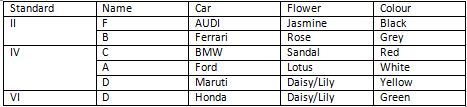
More Puzzles Questions
- Which of the following colour does Asha like?
- F lives to the north east of ___.
- Who among the following person lives immediate above flat of O?
- In the following question below are given some statements followed by some conclusions based on those statements. Taking the given statements to be true ev...
- Who lives on the ground floor of the building?
- What is the code for the word “To”?
- Who lives immediately above E in the same type of flat?
- Who among the following belongs to Delhi?
- Seven boxes, F, G, H, I, J, K and L, are kept one above other, such that bottommost box is numbered as 1 and topmost box is numbered as 7. F is a prime num...
- Seven students, L, M, N, O, P, Q and R, attend classes of seven activities on different days of the week starting from Monday. R attends Painting class on ...
Relevant for Exams:
Hey! Ask a query
Please enter email id
The email must be a valid email address.
Please enter Mobile Number
Please enter valid Mobile Number
Please enter your Doubt

Think You're Ready for RBI Grade B?
RBI Grade B 2026 Phase 1 Memory Based Paper
- 200 Questions with Detailed Solutions
- Section-wise Coverage (GA, English, Quant & Reasoning)