


Question
How many persons visits between the one, who visits Germany and the one, who has Yellow colour?
Study the following information carefully and answer the questions given below it. Seven persons namely – A, B, C, D, E, F and G visits different country viz. Australia, Canada, Bangladesh, Germany, China, France and Afghanistan from Monday to Sunday. Each of them has different colour viz. Red, White, BLACK, Yellow, Pink, Green and Blue. All the above given information is not necessary in same order. There were three days gap between the one who has Pink and the one who visits Afghanistan. The one, who visits Australia, visits on any day after Friday. There were two days gap between the one, who have Yellow and F who visits Australia. There were three days gap between D and the one who visits Bangladesh. One person visits between the one who visits Afghanistan and C, who has Red. The one, who visits China, visits on adjacent day of the one who has Green. At least three person visits between the one, who visits Germany and the one, who has Blue. There were two days gap between G and the one who likes White, who visits on adjacent day of the one who has Yellow. C neither visits on adjacent day of the one has Yellow nor on adjacent day of F. A visits Canada on Tuesday. G neither has Pink nor visits before the one who visits China and he visits France. D and the one who has BLACK, visits the cities on adjacent days. Neither D nor B visits Bangladesh. There were two days gap between A and the one who has Green.
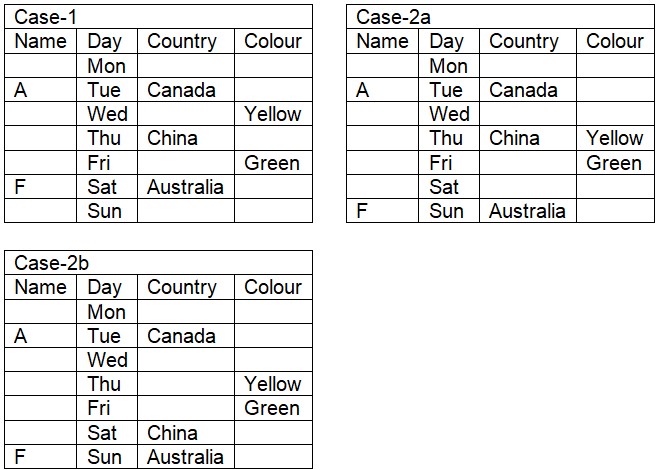 C neither visits on adjacent day of the one has Yellow nor on adjacent day of F. One person visits between the one who visits Afghanistan and C, who has Red, that means C visits on Monday. There were three days gap between the one who has Pink and the one who visits Afghanistan. G neither has Pink nor he visits before the one who visits China and he visits France. There were two days gap between G and the one who likes White, who visits on adjacent day of the one who has Yellow, that means case (2b) is not valid, in case (1) G visits on Friday, in case (2a) G visits on Saturday. Based on above given information we have:
 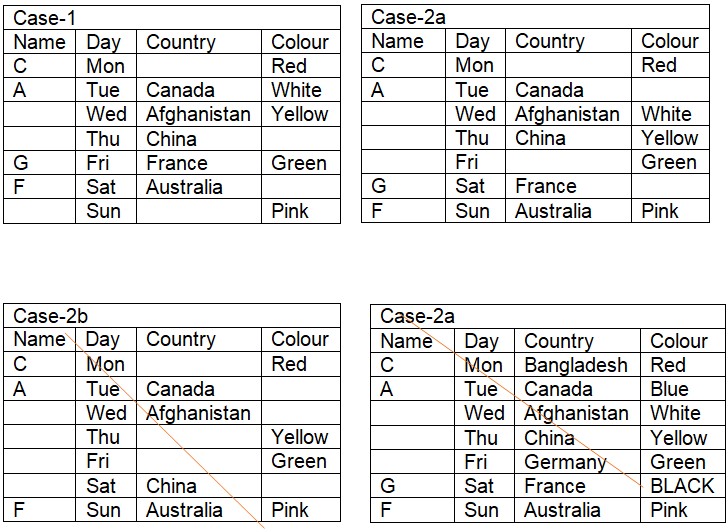 Case (2b) is not valid as G doesn’t visit before the one who visits China. The one who has BLACK and D visits on adjacent days. There were three days gap between D and the one who visits Bangladesh, that means in case (1) D visits on Wednesday, in case (2) D visits on Friday. Neither D nor B visits Bangladesh, that means in case (1) B visits China. At least three person visits between the one, who visits Germany and the one, who has Blue, that means case (2a) is not valid. Based on above given information we have final arrangement we have: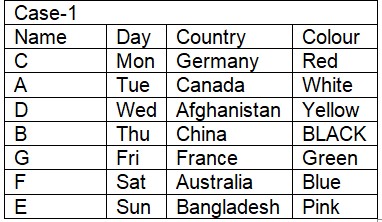
More Puzzles Questions
- Which combination represents Ishika’s favorite subject and the standard in which she studies?
- Which of the following combination is true?
- Five persons, G, H, I, J and K, live in a five storey building. The floor which is at the bottom is numbered as 1, the floor above it as 2 and so on. J liv...
- Seven boxes, F, G, H, I, J, K, and L, are kept one above the other, however not in this particular order. The box, which is at the bottom, is numbered as 1...
- If in a certain code language ‘deal work’ is coded as ‘ynr fik’, then which of the following is the code of ‘when talent school’?
- If Hemant was the first one to purchase the bungalow then how many persons bought bungalows between Hemant and Amit?
- Number of boxes above A is same as the number of boxes below which of the following box?
- How many persons stay between R and S?
- What is the code for the word “Be”?
- Which of the following combination is true?
Hey! Ask a query
Please enter email id
The email must be a valid email address.
Please enter Mobile Number
Please enter valid Mobile Number
Please enter your Doubt

Think You're Ready for RBI Grade B?
RBI Grade B 2026 Phase 1 Memory Based Paper
- 200 Questions with Detailed Solutions
- Section-wise Coverage (GA, English, Quant & Reasoning)