


Question
Which of the following pair represents vacant floors?
Study the following information carefully and answer the questions given below: Six People – S, T, U, V, W, and X live in eight different floors of building (but not necessarily in the same order). Two of the floors in the building are vacant. The lowermost floor of the building is numbered one, the one above that is numbered two, and so on till the topmost floor is numbered eight. Each one of them likes a different brands of laptop, namely Apple, Lenovo, Xiaomi, Asus, Dell and HP (but not necessarily in the same order). All have a different number of books 2, 3, 4, 5, 6 and 8 but not in same order. The difference of books of T and X is equal to the number of books hold by W. The number of floors above W is same as the number of floors between W and U. W lives an odd numbered floor above the floor numbered four. There are three people live between the two vacant floors. Only three floors between U and the one who likes Asus. The one who likes Dell lives immediately above
X. The difference of books of U and S is equal to the number of books hold by
V. Only three floors between X and S. The one who likes HP lives immediately above the one who likes Apple. T has more books than
X. T lives immediately above the one who likes Xiaomi. U has more books than S. The number of floors between W and the one who likes LENOVO is only one. The one who likes LENOVO Laptop immediately below one of the vacant floors. The floor number of the vacant floors are even – number. Only two floors are there between the one who likes HP and Asus. T lived immediately below one of the vacant floors and not on the ground floor. T neither lived on floor number 5 nor floor number 3. S has more than 3 books. The one who likes Lenovo lives on one of the floors below the floor number 4. X does not have 4 books. S has neither 2 nor 6 books. The number of books hold by T, X and W together is “4” less than the number of books hold by V, S and U together.
X. The difference of books of U and S is equal to the number of books hold by
V. Only three floors between X and S. The one who likes HP lives immediately above the one who likes Apple. T has more books than
X. T lives immediately above the one who likes Xiaomi. U has more books than S. The number of floors between W and the one who likes LENOVO is only one. The one who likes LENOVO Laptop immediately below one of the vacant floors. The floor number of the vacant floors are even – number. Only two floors are there between the one who likes HP and Asus. T lived immediately below one of the vacant floors and not on the ground floor. T neither lived on floor number 5 nor floor number 3. S has more than 3 books. The one who likes Lenovo lives on one of the floors below the floor number 4. X does not have 4 books. S has neither 2 nor 6 books. The number of books hold by T, X and W together is “4” less than the number of books hold by V, S and U together.
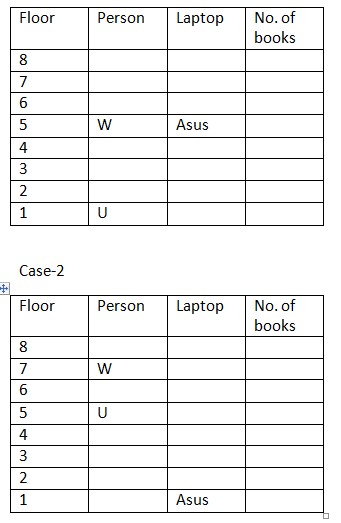 Only 2 floors are between Asus and HP. (so, we get another possible cases here). Case 1(a):
 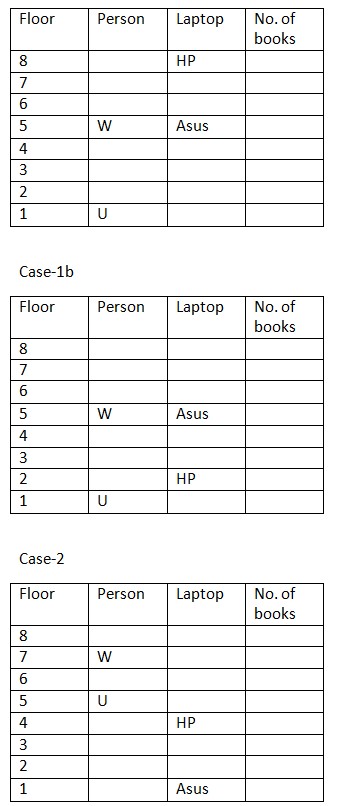 The one who likes HP lives immediate above Apple. There is one floor between W and lenovo. And it is also given that one who likes Lenovo lives somewhere below floor numbered 4. Floor immediately above one who likes Lenovo is vacant. (so, case 2 gets eliminated here). Case 1(a):
 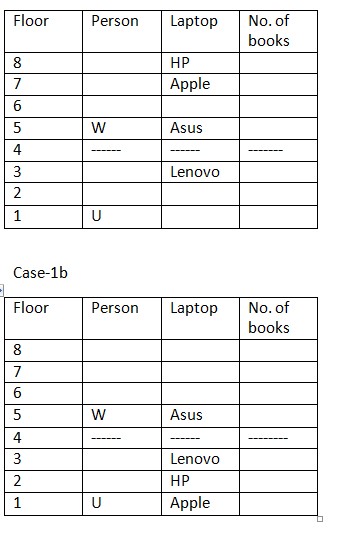 3 people live between 2 vacant floors and vacant floors are even numbered floors. (so, case 1(a) gets eliminated here as it does not satisfy the condition).
 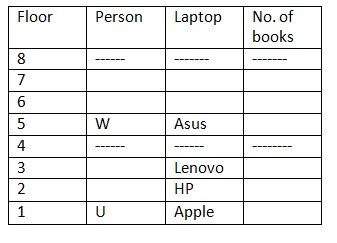 T lives immediately above the one who likes Xiaomi. X lives immediately below the one who likes Dell. Only 3 floors are between X and S.
 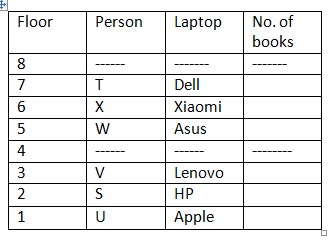 S has more than 3 books. And S has not 6 books. It is also given that U has more books than S. Difference between U and S books is equal to number of books V has.
 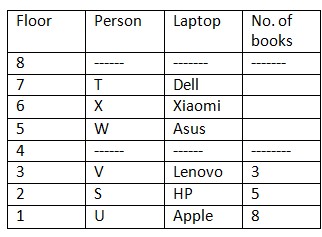 T has more books than X and difference between books of T and X is equal to books that W is having. X does not have 4 books.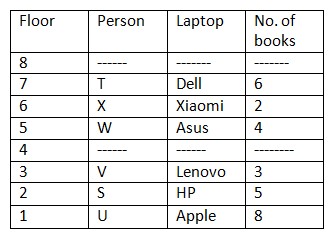
More Puzzles Questions
- ---------- lives on floor--------- in flat 3.
- Who among the following attends music class on Wednesday?
- Which of the following person likes Puma Shoes?
- Who lives two floors below O in the same type of flat as that of O?
- Who among the following sits exactly between the one who likes Sony and Z?
- Warranty period difference between Samsung and Dell is 4 months less than the warranty period difference between __and ___?
- Statements: Z ≤ Y < E < I; O > P > V > Q = I; Conclusions: I) Y > O II) Q > Z
- Who among the following live on topmost floor?
- How many boxes are placed between Papaya box and Chocolate box?
- Four of the following five are alike in a certain way and hence form a group. Which among the following one does not belong to the group?
Relevant for Exams:
Hey! Ask a query
Please enter email id
The email must be a valid email address.
Please enter Mobile Number
Please enter valid Mobile Number
Please enter your Doubt

Think You're Ready for RBI Grade B?
RBI Grade B 2026 Phase 1 Memory Based Paper
- 200 Questions with Detailed Solutions
- Section-wise Coverage (GA, English, Quant & Reasoning)