


Question
Four of the following five are alike in a certain way and hence form a group. Find the one who doesn’t belong to that group?
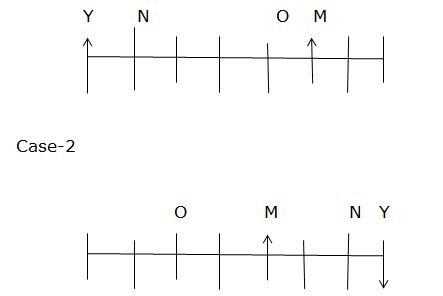 Only three persons sit between M and Z. Z is not facing the same direction as Y. C sits third to the right of B. Both C and B are facing the same direction. A sits second to the right of O. Both the immediate neighbors of M face opposite directions. Both O and N face the same direction as A. Hence, case 1 gets eliminated.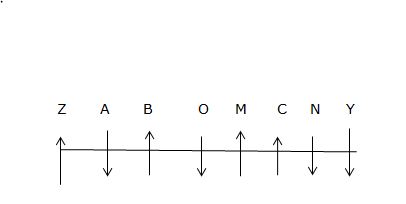
More Reasoning Miscellaneous Questions
- Consider the following statements: Assertion (A): The Himalayas were once submerged beneath the sea. Reason (R): Fossils of various marine creatures have b...
- Which of the following is used to transfer data between computers over the Internet securely?
- In a coding language, the code for ‘DUST’ is ‘@ % A $’, the code for ‘TOLD’ is ‘# @ $ B’ andthe code for ‘SAR’ is ‘% * F’. What will be the code for ‘DART’...
- The sale price of an item is set at 30% above the cost price. After giving a 10% discount on the marked price, what is the merchant’s profit percentage?
- What is Phishing in terms of computer security?
- Four letter-clusters are given out of which three are alike in some manner and one is different. Select the odd-one out.
- Which letter cluster will replace the question mark (?) in the following series? GWX, KRB, OMF, SHJ, ?, AXR
- Answer the questions based on the information given below. In a school, there are seven students (F, G, H, I, J, K and L) of different heights. J is shor...
- Find the value of ‘x’ in the following expression: (18/25) × (125/144) ÷ (3/16) + √625 = x + 5²
- Passage Since a diversified diet that meets all nutritional requirements is difficult to provide, fortification of food is relied upon by many countries ...
Relevant for Exams:
Hey! Ask a query
Please enter email id
The email must be a valid email address.
Please enter Mobile Number
Please enter valid Mobile Number
Please enter your Doubt

Think You're Ready for RBI Grade B?
RBI Grade B 2026 Phase 1 Memory Based Paper
- 200 Questions with Detailed Solutions
- Section-wise Coverage (GA, English, Quant & Reasoning)