


Question
Who among the following works in Yes?
Study the following information carefully and answer the questions below. A, E, M, N, O, Q, X, T and Y are sitting in a row in such a way that some are facing north while others sit facing south. Each person sits at a gap of 4m or 6m or 8m. Not less than two and not more than three person sits at same gap. None of the adjacent person sits at same gap. Each person works in different banks viz. PNB, UCO, SBI, Indian, DRDO, BOI, HDFC, ICICI and Yes. All the information is not necessarily in the same order. The one who works in BOI sits next to E, who neither works in yes nor Indian. The one who works in DRDO sits third to right of the one who works in UCO. The one who works in PNB sits on the immediate left of the one who works in Yes. The one who works in ICICI sits 12m to the right of M, who sits at left end. The one who works in BOI sits third to the right of X, who works in HDFC. O sits second to the left of Q and doesn’t work in BOI. The one who works in ICICI sits four places to the right of E. Two persons sit between E and Q, who neither works in DRDO nor SBI. Distance between the one who works in BOI and Q is 10m. Four persons sit between O and the one who works in PNB, who doesn’t sit adjacent to
M. T sits 14m from the one who works in
ICICI. The one who works in Indian sits 22m from Y. Number of persons left of A is half the number of persons left of the one who works in UCO. T neither works in BOI nor works in SBI. The one who works in Indian sits second to the right of N. The one who works in SBI and A sits faces same direction but opposite to the one who works in DRDO. A walks 12m towards south and takes a left turn of 20m. The one who works in UCO walks 8m straight and takes a left turn of 12m, he again takes a left turn of 20m. X walks 12m towards north and then takes a left turn of 18m. The one who works in Indian moves 8m towards north and then takes a left turn of 12m.
M. T sits 14m from the one who works in
ICICI. The one who works in Indian sits 22m from Y. Number of persons left of A is half the number of persons left of the one who works in UCO. T neither works in BOI nor works in SBI. The one who works in Indian sits second to the right of N. The one who works in SBI and A sits faces same direction but opposite to the one who works in DRDO. A walks 12m towards south and takes a left turn of 20m. The one who works in UCO walks 8m straight and takes a left turn of 12m, he again takes a left turn of 20m. X walks 12m towards north and then takes a left turn of 18m. The one who works in Indian moves 8m towards north and then takes a left turn of 12m.
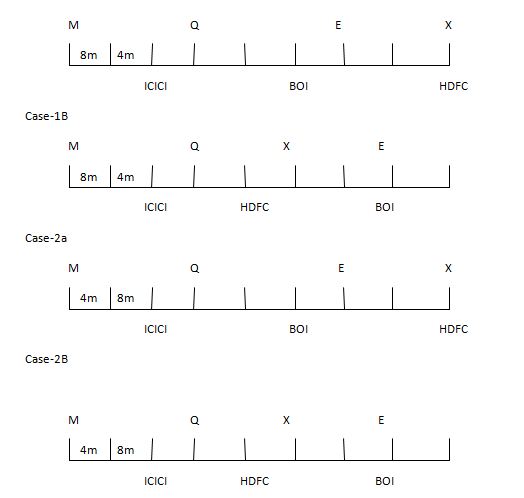 Again, we have: O sits second to left of Q and doesn’t work in BOI. Four person sits between O and the one who works in PNB, who doesn’t sit adjacent to M, that means Q sits facing north and O sits adjacent to M. The one who works in PNB sits immediate left of the one who works in Yes, that means in case (1a) & case (2a) the one who works in Yes sits facing north, in case (1b) & case (2b) the one who works in Yes sits facing south. T sits 14m from the one who works in ICICI, that means only possible combination of distance are (8 + 6), (6 + 8) & (4 + 6 + 4).T neither works in BOI nor works in SBI, that means in case (1a) & case (2a) T sits immediate right of Q and case (1b) & case (2b) is not valid. Distance between the one who works in BOI and Q is 10m, that means only possible combination is (6 + 4) & (4 + 6), thus, in case (1a) the distance between the one who works in ICICI and T is (8 + 6) & case (2a) is not valid. Based on above given information we have:
 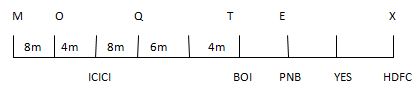 Case (1b) & case (2b) are not valid as T sits 14m from the one who works in ICICI, case (2a) is not valid as none of the adjacent person sits at same gap. Again, we have: The one who works in Indian sits second to right of N, that means in case (1a) M works in Indian and N sits third from left end facing south, in case (1c) T works in Indian and N sits third from left end facing north, in case (1d) Q works in Indian and N sits fourth from right end facing south. The one who works in Indian sits 22m from Y, that means in case (1d) Y sits second from right end and distance between Q and Y is (6 + 4 + 8 + 4), case (1a) & case (1c) is not valid. Since, at least two pair of person sits at a distance of 6m, thus distance between Y and X is 6m. The one who works in DRDO sits third to right of the one who works in UCO. Number of person left of A is half the number of person left of the one who works in UCO, that means A must sits facing north and the one who works in UCO sits facing south The one who works in SBI and A sits facing in same direction but opposite to the one who works in DRDO, that means M sits facing north and O sits facing south. Based on above given information we have: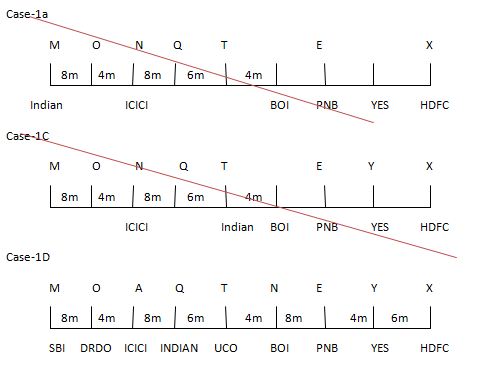
More Seating Arrangement Questions
- Who among the following likes Cauliflower?
- If Shishpal is related to Sonal, Swati is related to Pushpendra in a certain way. So in the same way Sandeep is related to who of the following?
- Arun, Bani, Chandu, Dena, and Emi are standing in a row facing the same direction. Dena is the immediate neighbor of Arun and Emi. Bani is at the right of ...
- P1, Q2, R3, S4, T5, and U6 are sitting around a circular table in a hotel, facing the center of the table. S4 is seated third to the right of U6. Q2 is the...
- Eight friends – A, B, C, D, E, F, G & H are sitting around a circle facing the center. G is third to the right of B & second to the left of C. B is second ...
- Which of the following statements is/are not true regarding I?
- Who among the following lives on the floor immediately above the floor of G?
- Who among the following person sits fourth to the left of G?
- If P is related to Kanpur, S is related to Jaipur in the given arrangement, Following the same pattern how is U related to ?
- Six persons N, O, P, Q, R and S sit in a linear row facing north. R is second to the left of N. Two persons sit to the right of S. Q sits immediate left of...
Relevant for Exams:
Hey! Ask a query
Please enter email id
The email must be a valid email address.
Please enter Mobile Number
Please enter valid Mobile Number
Please enter your Doubt

Think You're Ready for RBI Grade B?
RBI Grade B 2026 Phase 1 Memory Based Paper
- 200 Questions with Detailed Solutions
- Section-wise Coverage (GA, English, Quant & Reasoning)