
Question
Four of the five pairs are related to each other in some
way and thus form a group, then which of the following pairs is odd among all five? Study the following information carefully and answer the below questions. Ten person are sitting in two parallel rows containing five each, in such a way that there is an equal distance between them. In row 1 – F, G, H, I and J sit facing north, similarly in row 2 – R, S, T, U, and V sit facing south. Each person likes different fruits viz. Papaya, Apple, Banana, Mango, Watermelon, Grapes, Pineapple, Strawberry, Orange and Guava. All the information is not necessary in the same order. J sits at one end of the row three places away from the one who likes Strawberry. The one who likes Strawberry sits facing S. One person sits between S and the one who likes Guava. G neither likes Strawberry nor sits facing U. Two person sit between V and the one who sits facing G. G sits immediately right of the one who likes Watermelon. The one who likes Orange and the one who likes Papaya sits together. The one who likes Papaya sits facing the one, who sits second to left of the one who likes Banana. The one who likes Banana neither sits at the end of the row nor sits in the same row of the one who likes Apple. I sits facing the one who likes Pineapple and is adjacent to F. The one who likes Orange sits facing the one who likes Mango. T neither sits facing the one who likes Grapes nor sits facing the one who likes Orange. F neither sits facing the one who likes Banana nor sits facing T. One person sits between U and T.Solution
We have: J sits at either end of the row three places away from the one who likes Strawberry. The one who likes Strawberry sits facing S. One person sits between S and the one who likes Guava, that means in case (1) J sits at left end of row 1, in case (2) J sits at right end of row 2. Two person sits between V and the one who sits facing G. G neither likes Strawberry nor sits facing U. G sits immediate right of the one who likes Watermelon, that means in case (1) V sits at left end of row 2, in case (2) V sits at right end of row 2. Based on above given information we have: Case-1 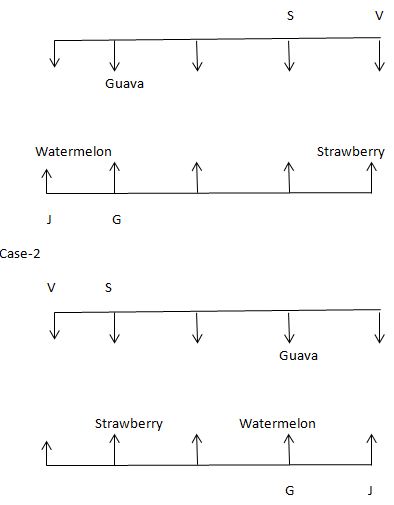 Again, we have: The one who likes Orange and the one who likes Papaya sits together. The one who likes Papaya, sits facing the one, who sits second to left of the one who likes Banana. The one who likes Banana neither sits at end of the row nor sits in same row of the one who likes Apple. The one who likes Orange sits facing the one who likes Mango, that means in case (2a) the one who likes Papaya sits second from right end of row 2, in case (2b) the one who likes Papaya sits second from right end of row 1, case (1) is not valid. I sits facing the one who likes Pineapple and is adjacent to F. F neither sits facing the one who likes Banana nor sits facing T, that means in case (2a) I likes Watermelon and case (2b) is not valid. Based on above given information we have: Case-2a
  Case (1) is not valid as the one who likes Papaya, sits facing the one, who sits second to left of the one who likes Banana & case (2b) is not valid as F neither sits facing the one who likes Banana nor sits facing T. Again, we have: Since, the one who likes Banana and the one who likes Apple doesn’t sit in same row, that means the one who likes Apple sits at left end of row 2. One person sits between U and T. T neither sits facing the one who likes Grapes nor sits facing the one who likes Orange, that means U sits at left of the row 2. As, the only remaining person is R, thus R likes Guava. Based on above given information we have final arrangement as follow:
Which of the following is a kingdom of organisms?
I. Monera
II. Protista
- Which hormone is secreted when blood sugar levels are low?
How many types of plant tissues are there?
Photosynthesis takes place inside plant cells in:
Which gland in the human body functions as both an endocrine and exocrine gland?
The amount of light entering the eye is controlled by the_________.
Which of the following statement is correct?
I. Arteries are the vessels which carry blood away from the heart to various organs of the body <...
The contraction of the heart is also known as:
The Bt toxin in Bt crops kills insects by:
- Which of these is a fat-soluble vitamin?
Relevant for Exams:


