
Question
Who among the following sits opposite to
N? Read the following information carefully and answer the given questions. Ten people are seating on two parallel rows. M, N, O, P and Q are sitting in row 1 and facing towards south. F, G, H, J and K are sitting in row 2 and facing north. They like different colours - White, Green, Blue, Red, Yellow, Brown, Purple, Black, Pink and Magenta (not necessarily in the same order). M likes White and sits one of the extreme end of the row. Only two persons sit between the one who likes Magenta and the one who likes Pink. The one who likes Blue faces the one who sits immediate right of the one who likes Black. There are only two persons sit between M and the one who likes Red. J sits third to the left of F. G likes Yellow and sits one of the extreme end of the row. Only two persons sit between M and P. The one who likes Magenta sits diagonally opposite to the one who likes Brown. The one who like Green faces north. The one who likes Pink is not an immediate neighbour of M. The one who likes Purple faces the person who likes Blue. H is not an immediate neighbour of the one who likes Magenta. J neither likes Magenta nor Brown. Q sits third to the right of the one who likes Black. K doesn’t face N.Solution
Explanation : (i)- By using definite conditions, M likes White and sits one of the extreme end of the row (thus in case1-A either sit at the extreme right end and in case2- M sits at the extreme left end of the row). Only two persons sit between M and P. There are only two persons sit between M and the one who likes Red (that means P likes Red). 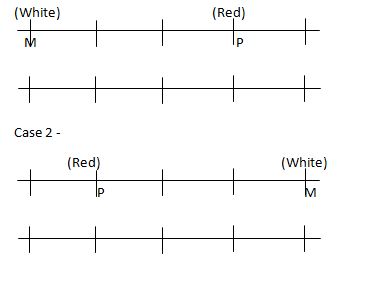 (ii)- G likes Yellow and sits one of the extreme end of the row. J sits third to the left of F. J neither likes Magenta nor Brown (from all these conditions case1 will be eliminated and in case2- G sits at the extreme left end of the row then J sits to its immediate right and F at the right end of the row). The one who likes Magenta sits diagonally opposite to the one who likes Brown. Now in case2, there will be two possible cases, case-2(a) and case2 (b); as shown below: Case 2(a)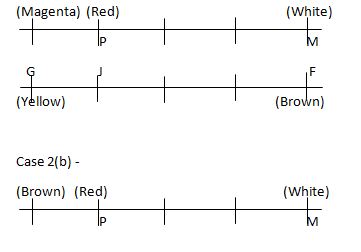
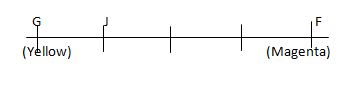 (iii)- H is not an immediate neighbour of the one who likes Magenta. Only two persons sit between the one who likes Magenta and the one who likes Pink. The one who likes Pink is not an immediate neighbour of M (from this case2 (a) will be eliminated). Q sits third to the right of the one who likes Black (Q likes Brown is fixed). The one who likes Green faces north (thus it is fixed in row-2). Now, the one who likes Purple faces the person who likes Blue. The one who likes Blue faces the one who sits immediate right of the one who likes Black (from this it is clear that the one who likes Black faces the one who likes Green). K doesn’t face N (thus K faces O). The final arrangement will be: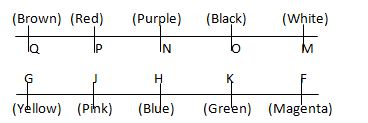
In a certain code language, STATION is coded as 21-22-3-22-11-17-16, and CRUEL is coded as 5-20-23-7-14. How will VIXEN be coded in that language?
Select the word which does not belong to the same group from the given alternatives.
Which of the following can be the code for 'hits' in the given language?
In a certain code language, ‘HEN’ is written as ‘27’ and ‘FOG’ is written as ‘28’. What will be the code for ‘LAP’ in that code lang...
If ALGORITHM is coded as 6 and FEATHER as 4, what is the code for DEPRESSION ?
In a certain code language, ‘91449114’ is related to 'INDIAN' in the same way ‘1051819525’ is related to which of the following words?
...In a certain code language, ‘INVITATION’ is coded as ‘JMWHUZUHPM’. How will ‘RECESSION’ be written in that language?
In a certain code language, BARREN is written as FDVUIQ. How will MOSTLY be written in that language?
In a certain code language, ‘PORE’ is written as ‘56’ and ‘MALL’ is written as ‘40’. What will be the code for ‘HURT’ in that code l...
Select the letter-cluster from among the given option that can replace the question mark (?) in the following series.
G, I, L, N, Q, ?
Relevant for Exams:

