


Question
Who is sitting second to the right of G?
Answer the questions based on the information given below. There are 7 persons A, B, C, D, E, F and G sitting around square table, where four of them were sitting in the middle of the edges and three are sitting at the corners. Each of them is of different ages among- 2, 3, 5, 8, 9, 10 and 12. Each of them is facing towards the center of the table. E, who is sitting at the edge, is sitting second to the right of C, who is 8 years old. F, who is the oldest person, is sitting three places away from E and is sitting at the corner. G, who is 1 year elder than D, is sitting opposite to
D. A is 2 years elder than B, and both of them are either sitting at the corner or at the edge. A and G are not immediate neighbors.
D. A is 2 years elder than B, and both of them are either sitting at the corner or at the edge. A and G are not immediate neighbors.
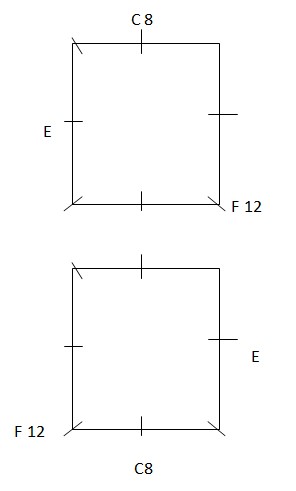
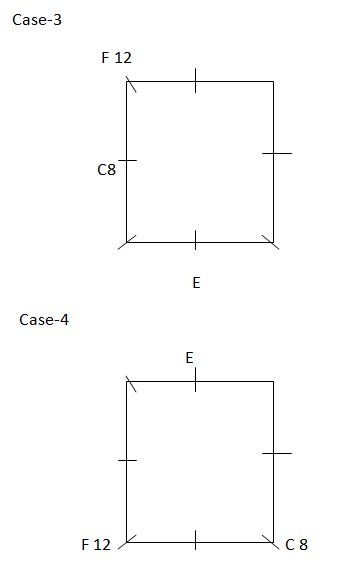 G, who is 1 year elder than D, is sitting opposite to D. A is 2 years elder than B, and both of them are either sitting at the corner or at the edge. A and G are not immediate neighbors. Now, G is sitting opposite to D which is not possible in case I and III so, these cases are rejected. Also, in case IV, if we place G and D opposite then we can’t place A and B on the same side of the table so, case IV is also rejected. A must be 5 years old and B must be 3 years old also, D must be 9 years old which means G is 10 years old. Then final arrangement is shown below: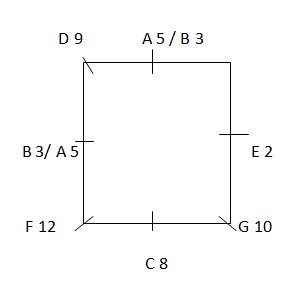
More Seating Arrangement Questions
- Which of the following statement(s) is/are true? I. F and A are immediate neighbors II. Only one person sits between K and T when counted from the left of ...
- Which of the following is not correct regarding F?
- How is I related to K?
- In which of the following combination both the persons are facing towards each other?
- Which of the following statement is not true before the final arrangement?
- How many persons sit between the one who sits to the immediate right of F and the one who sits to the immediate right of C?
- Who is sitting second to the left of L?
- Eight friends, A, B, C, D, E, F, G and H, are sitting in a straight line, all facing the north. F is sitting between D and G. B is sitting between H and A....
- How many person sit between one who likes grapes and one who lives in Kerala?
- Six people L, M, N, J, P and R are sitting around a circular table, facing towards the centre. M is sitting second to the right of J. One person is sitting...
Relevant for Exams:
Hey! Ask a query
Please enter email id
The email must be a valid email address.
Please enter Mobile Number
Please enter valid Mobile Number
Please enter your Doubt

Think You're Ready for RBI Grade B?
RBI Grade B 2026 Phase 1 Memory Based Paper
- 200 Questions with Detailed Solutions
- Section-wise Coverage (GA, English, Quant & Reasoning)