


Question
Who sits fifth to the right of J?
Study the following information carefully and answer the below questions. Eight people D, T, O, L, J, A, C, and G are seated around the circular table. All the persons are facing towards the table but not necessarily in the same order. D sits three places away from O who sits second to the right of
C. A sits second to the left of T. Neither O nor D is an immediate neighbour of T. The number of persons who sit between L and O is one less than the number of persons who sit between G and J when counted from the right of G and
L. L doesn’t sit next to O.
C. A sits second to the left of T. Neither O nor D is an immediate neighbour of T. The number of persons who sit between L and O is one less than the number of persons who sit between G and J when counted from the right of G and
L. L doesn’t sit next to O.
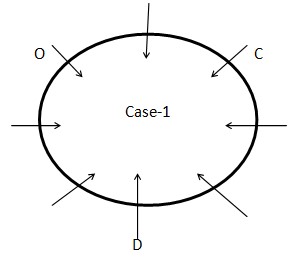
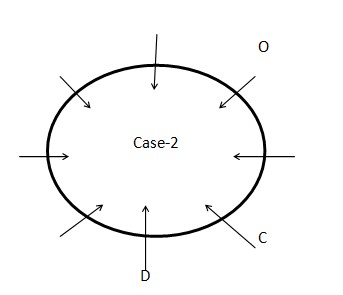 A sits second to the left of T. Neither O nor D is an immediate neighbour of T. so case-1 is eliminated
 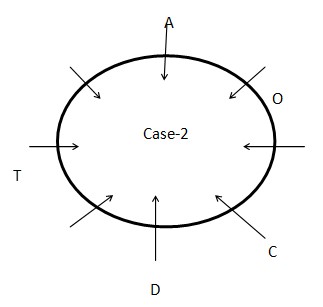 The number of persons who sit between L and O is one less than the number of persons who sit between G and J when counted from the right of G and L. L doesn’t sit next to O.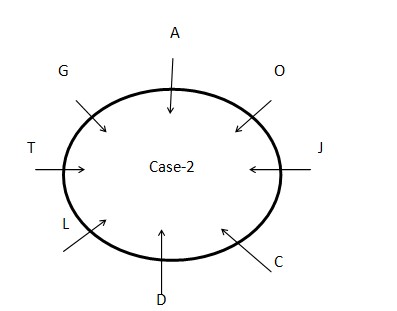
More Seating Arrangement Questions
- Five of the following are alike in a certain way and hence form a group. Which is not the part of the group?
- Who among the following sits second to the left of C?
- Who is sitting between Garima and Ruchi?
- If all the persons are arranged in alphabetical order in the clockwise direction with respect to A, then how many persons remain unchanged in their positio...
- Which of the following pairs represent those who sit at the extreme ends of the line?
- Eight friends, A, B, C, D, E, F, G and H, are sitting in a straight line, all facing the north. F is sitting between D and G. B is sitting between H and A....
- How many seats are there around the table?
- Who is sitting second to the left of Y?
- Which of the following statement is correct about K5?
- Six friends A, L, K, D, B and G are sitting on a bench facing towards north. 'A' is sitting second to the left of 'G' And 'G' is sitting fourth to the righ...
Relevant for Exams:
Hey! Ask a query
Please enter email id
The email must be a valid email address.
Please enter Mobile Number
Please enter valid Mobile Number
Please enter your Doubt
