
Question
Who among the following faces
M? Answer the given questions based on the information given below. Sixteen persons are sitting around the two square tables. One square table is inscribed in another. Two persons sit on each side of the table. The persons on the inner table have different number of balls while the persons on outer table like different colours. J, K, L, M, N, O, P and Q sit on one table while A, B, C, D, E, F, G and H sit on another table. Each of the persons on both tables is facing the closest person opposite to them on different tables such that the persons on inner table are facing outwards while persons on outer table are facing inwards. Persons on inner table have different number of balls from 1 to 8. Also, persons on outer table like different colours among, red, black, pink, yellow, white, grey, blue and green. Note: If A is facing B then both are sitting opposite to each other on the different tables but on the nearest seat. J sits opposite to one, who sits to the immediate left of L, who has 3 balls. Both J and L are sitting on the opposite sides of the same table. The persons facing L is three places away from D. Q has twice number of balls of M, who has 3 balls more than K. K faces E, who likes yellow color. O sits to the immediate right of P, who has 7 balls, on the same side. A, who likes white color, faces O, who has 6 balls. E does not sit adjacent to A or C and K is not adjacent to L. C, who likes green color, sits second to the right of A. G sits to the immediate right of F, who likes red color and both sit on the same side. P has 2 more balls than N, who does not face G. The one, who has 4 balls, faces B, who likes Pink. M is not adjacent to J, who is not to the immediate right of N. G does not like Grey or Blue color.Solution
J sits opposite to one, who sits immediate left of L, who has 3 balls. Also, both sit on same table. The persons facing L is three places away from D. Q has twice number of balls than that of M, who has 3 balls than K. So, K, M and Q have 1, 4 and 8 balls respectively. K faces E, who likes yellow color. O sits immediate right of P, who has 7 balls, on the same side. A, who likes white color, faces O, who has 6 balls. C, who likes green color, sits second to the right of A. G sits to the immediate right of F, who likes red color and both sit on the same side. So, we have four cases, Case-1a 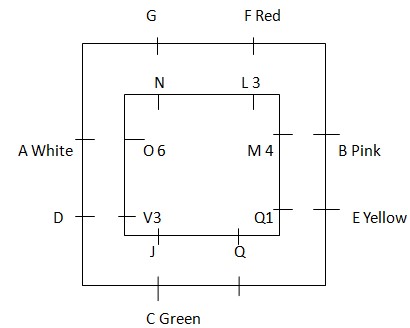 Case-1b
 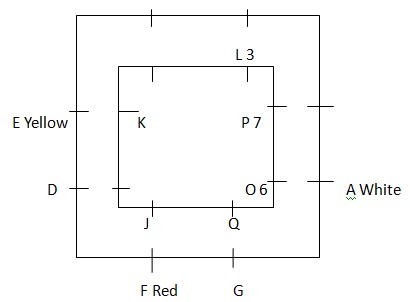 Case-2a
 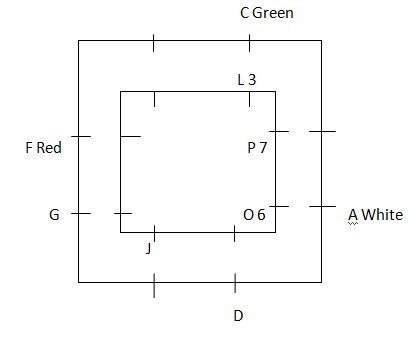 Case-2b
 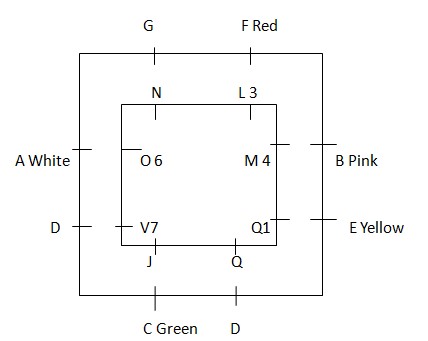 E does not sit adjacent to A or C and K is not adjacent to L. So, case 2(a) is rejected. P has 2 more balls than N, who does not face G. So, case 1(a) and 2(b) are rejected. The one, who has 4 balls, faces B, who likes Pink. M is not adjacent to J, who is not immediate right of N. G does not like Grey or Blue color. So, we have, Case-1b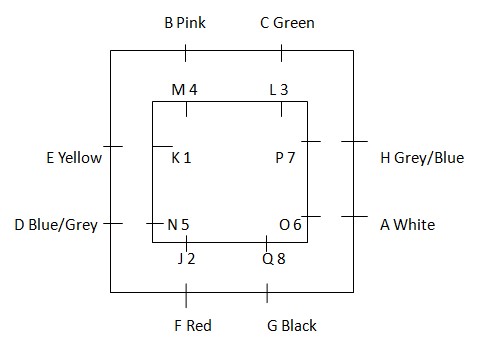
GSTN is a -----------
A company claims depreciation of ₹15 lakhs as per tax laws but only ₹10 lakhs as per books. How should this temporary difference be treated?
For intra-State sales, the GST is divided between the Centre and the State in the ratio?
As per Companies Act 2013, Payment of Dividend is dealt U/S:
Company had opening deferred tax liability (DTL) ₹50,000. Due to tax rate change enacted after reporting date, DTL must be remeasured to ₹45,000. Th...
Which type of budget is prepared for a range of activity levels rather than a single level?
As per the provision of Section 40 of the Companies Act, 2013, the commission paid or agreed to be paid does NOT exceed in the case of debentures _____o...
Other things remaining the same, infusion of fresh equity will ______ the credit profile of a company.
Which of the following is NOT a best practice under Green Computing?
X Ltd. provides you the following information to calculate P/V ratio.
Fixed cost = Rs. 40,000, Break-even point = Rs. 1,00,000
Relevant for Exams:

