
Question
How many person sit between F and E?
Answer the questions based on the Information given below. Eleven person A, B, C, D, E, F, G, H, I, J and K are sitting in the straight line. Some of them are facing north and some of them are facing south. Not more than two person of immediate neighbour are facing same direction. All the information are not necessarily in the same order. Note: Immediate neighbour are opposite direction means one person is facing north while another person is facing south. If same direction means one person is facing north while another is also facing north. Less than three person sit between A and B, who is facing opposite directions of C. Two person sit between F and J. Number of person sit to the left of I as same as number of person sit to the left of C. A sits fifth to the right of one who is second to the right of B. Neither F nor I sits at the extreme end of the row. Two person sits to the right of G, who is facing same directions of A. F sits some where to the left of A. E sits four place away from H and who not facing north. Immediate neighbour of G are facing same directions. E sits to the right of H, who is facing same direction of E. Both extreme end persons are facing opposite directions. G sits three place away from the B and who not immediate neighbour of D. A and B are facing in same direction. E doesn’t sit at any ends.Solution
Less than three person sit between A and B. A sits fifth to the right of one who is second to the right of B. A and B are facing in same direction. 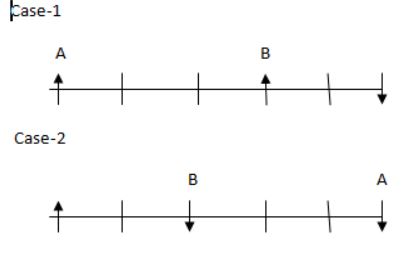 Two person sits to the right of G, who is facing same directions of A. G sits three place away from the B
 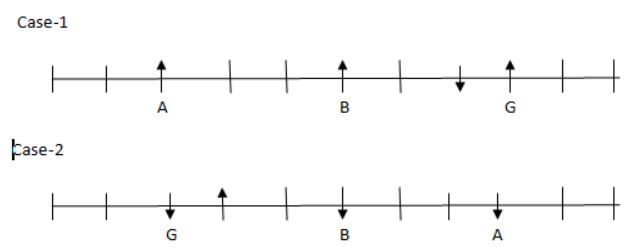 Neither F nor I sits at the extreme end of the row. F sits some where to the left of A Two person sit between F and J
 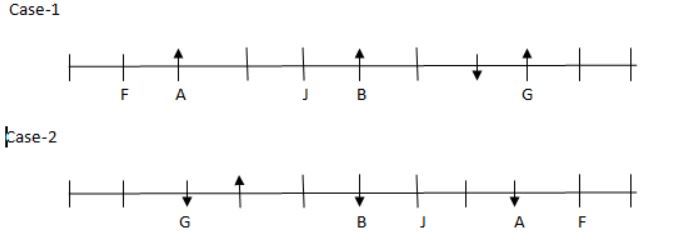 B, who is facing opposite directions of C. Number of person sit to the left of I as same as number of person sit to the left of C. Case 2 is not valid, because E sits four place away from H and who not facing north. E sits to the right of H, who is facing same direction of E. E doesn’t sit at any ends.
  G is not immediate neighbour of D Immediate neighbour of G are facing same directions. Both extreme end persons are facing opposite directions. Final arrangements as follows,
Find the total distance covered by boat in each upstream and downstream in 4 hours if the speed of boat in still water and speed of current is 15 km/h a...
Speed of a boat in still water is 12 kmph and speed of stream is 9 kmph. A man rows to a place at a distance of 63 km and come back to starting point. T...
A boat can cover 60 km in still water and 75 km in downstream in 4 hours and 3 hours respectively. Find the time taken by the boat to cover 60 km upstre...
A boatman rows 216 km upstream in 6 hours and 432 km downstream in 6 hours. How long will it take to row 324 km in still water?
A man can row at 2 kmph in still water. If the velocity of current is 1 kmph and it takes him 4 hour to row to a place and come back, how far is the place?
A boat can travel 36 km downstream in 40 min. The ratio of the speed of the boat in still water to the speed of the stream is 5: 4. How much time will t...
A boat takes 14 hours to travel 112 km against the current. If the speed of the current is 4 km/hr, how much time will it take for the boat to travel 19...
The speed of a boat in still water is 20 km/hr. If the boat covers 90 km in upstream in 9 hours, then find the time taken by the boat to travel 150 km i...
A boat takes 270 minutes to travel 90 km in upstream. The same boat in the same stream takes 120 minutes to travel 50 km in downstream. Find the distanc...
A boat can cover 140 km in downstream in 7 hours and 130 km in upstream in 13 hours. Find the speed of boat in still water.


