


Question
Who likes Blue?
Answer the questions based on the information given below. Eight persons A, B, C, D, E, F, G and H are sitting around a circular table facing inside but not necessarily in the same order. All of them likes different colour viz. Red, Green, Yellow, Blue, White, Black, Pink and Cream but not necessary in same order. Only one person sits between E and the one who likes Red. A sits second to the left of the one who likes Red. H is an immediate neighbour of
C. C is not an immediate neighbour of A or E and he does not likes Black. E sits second to the left of the one who likes Black. Only three people sit between the one who likes Green and the one who likes Yellow. F sits second to the left of the one who likes Yellow. H does not likes Blue. The one who likes Blue is not an immediate neighbor of H. D sits on the immediate left of the one who likes Blue. The one who likes Pink sits on the immediate right of the one who likes Cream. Only two persons sit between G and the one who has likes Black. The one who likes Green sits second to the right of H.
C. C is not an immediate neighbour of A or E and he does not likes Black. E sits second to the left of the one who likes Black. Only three people sit between the one who likes Green and the one who likes Yellow. F sits second to the left of the one who likes Yellow. H does not likes Blue. The one who likes Blue is not an immediate neighbor of H. D sits on the immediate left of the one who likes Blue. The one who likes Pink sits on the immediate right of the one who likes Cream. Only two persons sit between G and the one who has likes Black. The one who likes Green sits second to the right of H.
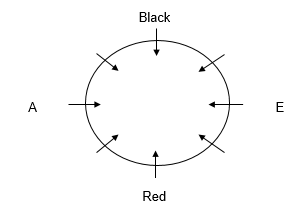 Only two persons sit between G and the one who has likes Black. From this statement, we will have two cases: G will sit either at place no. 2 or 8. H is an immediate neighbour of C. C is not an immediate neighbour of A or E and he does not like Black. The one who likes Green sits second to the right of H. C cannot sit at places no. 6, 5, 4, and 8. So, the only place left for him is place no. 1. As H is an immediate neighbour of C. So, H will sit either at place no. 8 or 2. The one who likes Green sits either at place no. 4 or 2. Only three people sit between the one who likes Green and the one who likes Yellow. So, the one who likes Yellow sits either at place no. 6 or 8. F sits second to the left of the one who likes Yellow. So, F sits either at place no. 4 or 6.
 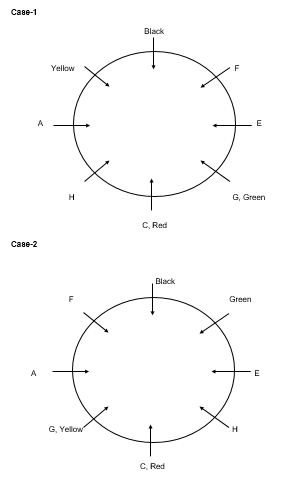 H does not likes Blue. The one who likes Blue is not an immediate neighbor of H. D sits on the immediate left of the one who likes Blue. The one who likes Pink sits on the immediate right of the one who likes Cream. Case 1 will get discarded as the one who likes Blue cannot sit at place no. 7 and 8. If the one who likes Blue sits either at place no. 4 or 3, then there is no place for D as D sits on the immediate left of the one who likes Blue In case 2, if the one who likes Blue sits at place no. 6, then D sits at place no. 5. The one who likes Pink and the one who likes Cream sit at place no. 3 and 2 respectively Only person left for place no. 4 is B. Only colour left for A is White.
 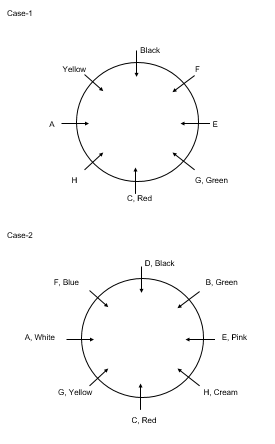 Case - 2 is the final arrangement.
 More Seating Arrangement Questions
- If all the letters in the word ‘UNDERGROUND’ are arranged in alphabetical order from left to right such that the vowels are arranged first followed by the ...
- Six persons, F, G, H, I, J and K, sit around a circular table and face towards the centre. Distance between any two adjacent persons is same. K sits adjace...
- X has tuition centre in which place?
- Six tractors KZ, MZ, OZ, QZ, SZ, and UZ are parked around a circular parking space facing towards the centre (not necessarily in the same order). QZ is sec...
- Which of the following statements is definitely true as per the given arrangement?
- Eight persons, R, S, T, U, V, W, X and Y, sit around a square table and faces towards the centre of the table. Four of them sit at the corner of the table ...
- Four out of five pair follow a certain rule and thus form a group, then which of the following pair doesn’t belong to that group?
- How is O related to T’s brother?
- U, V, W, X, Y and Z are sitting around the circular table facing towards the center. V sits second to the left of U. X sits opposite to Z, who is not adjac...
- Which of the following statement are true? I. H likes brown II. A sits opposite to C III. The one who likes Black sits immediate left of C IV. No one sits ...
Hey! Ask a query
Please enter email id
The email must be a valid email address.
Please enter Mobile Number
Please enter valid Mobile Number
Please enter your Doubt

Think You're Ready for RBI Grade B?
RBI Grade B 2026 Phase 1 Memory Based Paper
- 200 Questions with Detailed Solutions
- Section-wise Coverage (GA, English, Quant & Reasoning)