


Question
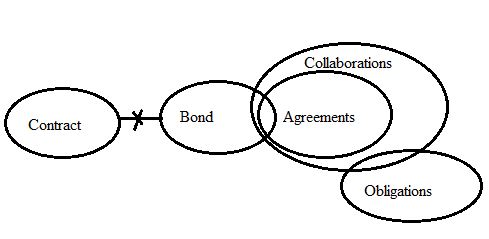
Statements: No contract is a bond. Some bonds are agreements. All agreements are collaborations. Some collaborations are obligations. Conclusions:
Statements: No contract is a bond. Some bonds are agreements. All agreements are collaborations. Some collaborations are obligations. Conclusions:
I. Some bonds are not collaborations.
II. Some agreements are not contracts.
III. Some obligations are agreements.
IV. Some bonds are not contracts.
In each of the questions below are given four statements followed by four conclusions numbered I, II and III and
IV. You have to take the given statements to be true even if they seem to be at variance with commonly known facts. Read all the conclusions and then decide which of given conclusions logically follows from the given statements disregarding commonly known facts .
IV. You have to take the given statements to be true even if they seem to be at variance with commonly known facts. Read all the conclusions and then decide which of given conclusions logically follows from the given statements disregarding commonly known facts .
More Syllogism Questions
- Statement: All Mathematics are Economics Only a few Mathematics are Chemistry No Chemistry is Physics Conclusion: I. All Chemistry are Economics II. Some E...
- In the question below some statements are given followed by three conclusions I, II and III. You have to take the given statements to be true even if they ...
- Some streets are not stones. Some bricks are not roads.
- Statements: Some laptop are tablet. Some tablet are computer. Conclusions: I. All laptop are computer. I...
- Statements: Some One is two Only a few two are three All three are four Only a few four are five Conclusions: I). Some one is five II). All four are tw...
- Statements:All Januarys are Februarys. No February is March. All marches are Aprils. Conclusions:I. some March are not Februarys. II. Some marches are...
- Statement: Some Red are Blue. Only a few Blue are Green. Conclusion: I. Some Red are Green is a possibility. II. All...
- Three statements are given followed by three conclusions numbered I, II and III. Assuming the statements to be true, even if they seem to be at variance wi...
- Conclusions: I. All Writers can be Novels. II. Some Novels are not Magazines. Statements:
- Statements: Some years are months. Some months are days. Some days are weeks. Conclusions: I. No year is a day. II. Some days are years. III. Some months a...
Hey! Ask a query
Please enter email id
The email must be a valid email address.
Please enter Mobile Number
Please enter valid Mobile Number
Please enter your Doubt

Think You're Ready for RBI Grade B?
RBI Grade B 2026 Phase 1 Memory Based Paper
- 200 Questions with Detailed Solutions
- Section-wise Coverage (GA, English, Quant & Reasoning)