
Question
Statements:Some villages are towns. Some towns
are huts. All huts are rivers. Some rivers are tents. Conclusions:I. Some tents are towns. II. Some rivers are towns. III. Some huts are villages. In each question below are given four statements followed by three conclusions numbered I, II and III. You have to take the two given statements to be true even if they seem to be at variance with commonly known facts and then decide which of the given conclusions logically follows from the two given statements, disregarding commonly known factsSolution
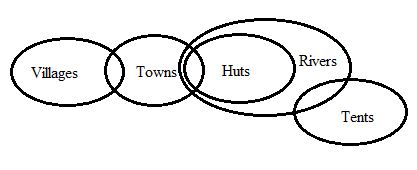 Some towns are huts(I) + All huts are rivers(A) ⇒ Some towns are rivers(I) + Some rivers are tents(I) ⇒ No Conclusion. Hence conclusion I does not follow. Some towns are huts(I) + All huts are rivers(A) ⇒ Some towns are rivers(I) ⇒ Conversion ⇒ Some rivers are towns(I). Hence conclusion II follows. Some villages are towns(I) + Some towns are huts(I) ⇒ No conclusion. Hence conclusion III does not follow.
What is the primary advantage of using a snapshot-based backup method over traditional backup methods?
Which of these can be overloaded?
Running time T(n) where 'n' is the input size of the recursive algorithm given as : T(n) = c + T(n-1), if n > 1 ; T(n) = d if n < 1. The order of the a...
Which key is kept secret and known only to the owner in a public key pair?
In a digital signature scheme, what does the process of "signing" mean?
What is a smart contract in the context of blockchain technology?
In a 2-to-1 multiplexer, how many select lines are required to choose between two data inputs?
Which element in HTML5 is used to indicate navigation links within a document?
Which SQL clause is used to specify conditions for multiple tables when joining them together?
What is the routing table in a router used for?

