


Question
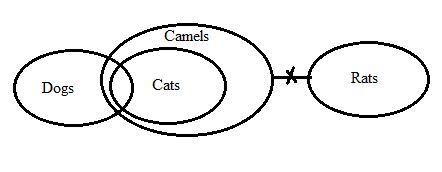
Statements: Some dogs are cats. No camel is a rat. All cats are camels. Conclusions:
Statements: Some dogs are cats. No camel is a rat. All cats are camels. Conclusions:
I. All dogs may be camels.
II. Some dogs may not be camels.
In each of the questions below are given three statements followed by two conclusions numbered I and
II. You have to take the given statements to be true even if they seem to be at variance with commonly known facts. Read both the conclusions and then decide which of given conclusions logically follows from the given statements disregarding commonly known facts. Give answe
II. You have to take the given statements to be true even if they seem to be at variance with commonly known facts. Read both the conclusions and then decide which of given conclusions logically follows from the given statements disregarding commonly known facts. Give answe
More Syllogism Questions
- In the question below some statements are given followed by two conclusions I and II. You have to take the given statements to be true even if they seem to...
- Statements: All Parrot are Sparrow. All Pigeon are Sparrow. Few Penguin are Parrot. Conclusions: I. Every Pigeon is Parrot. II. Few Penguin are Sparrow. II...
- Statements: All jacket are coat. All coat are blazzers. All blazzers are shirt. Conclusions: I. All shir...
- In the question below, there are two conclusions followed by three statements in the options. You have to take the three given statements to be true even i...
- Statements: Only a few rats are rabbit. Some rabbits are parrot. Only a few parrot ...
- Statements: Only BB are LL. Only a few BB are DD. No BB is AA. A few AA are OO. Conclusions: I. At least Some BB are not DD. II. Some LL being OO is...
- Statements: Only a few passage is comprehension A few comprehension is language All language is story Conclusions: I. Some passage is not comprehensio...
- In the question below there are three statements followed by two conclusions I and II. You have to take the three given statements to be true even if they ...
- Statements: Some creams are butters. Some butters are cakes. No cake is a bread. Conclusion: I. Somecakes may not be butters. II. Some butters are no...
- Statements: All pearls are diamonds. All diamonds are gold All gold are silvers. Conc...
Hey! Ask a query
Please enter email id
The email must be a valid email address.
Please enter Mobile Number
Please enter valid Mobile Number
Please enter your Doubt

Think You're Ready for RBI Grade B?
RBI Grade B 2026 Phase 1 Memory Based Paper
- 200 Questions with Detailed Solutions
- Section-wise Coverage (GA, English, Quant & Reasoning)