


Question
Read the given statements and conclusions carefully. Assuming that the information given in the statements is true, even if it appears to be at variance with commonly known facts, decide which of the given conclusions logically follows) from the statements. Statements: All capitalists are rich. No Indians are capitalists. Conclusions: (
- I No Indians are rich. (Il) Some capitalists are Indian.
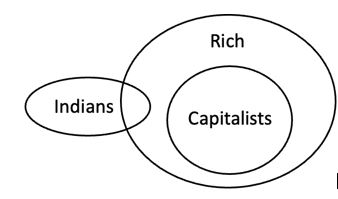 The given statements never say that only the capitalists are rich. So, it is possible for Indians to be rich and yet not be capitalists. Thus, Conclusion I is invalid. Conclusion II clearly contradicts the fact given in the second statement. If no Indians are capitalists, then there is no way some capitalists can be Indians. Thus, Conclusion II is also invalid. Hence, the correct answer is (D).
More Alphabetical Coding Questions
- In a certain code language, SAFETY is written as 21 – 3 – 8 – 7 – 22 – 27. How will FRIEND be written in that code language?
- If all the vowels in the word ‘REJECTION’ are changed to the next letter in the English alphabetical order and all the consonants remain the same then all ...
- What is the code of “Recommendation Ruled”?
- Arrange the following in the English alphabetical order: (i) Exploration (ii) Exploitative (iii) Exploratory (iv) Exploitation
- How many pairs of letters are there in the word ‘FARMHOUSE’ each of which have as many letters between them (both forward and backward direction) in the wo...
- How is R related to S?
- Seven persons are sitting around a circular dining table facing the towards the centre. S is sitting to the immediate left of Y and third to the right of R...
- If CAT is coded as 8 and DEAF is coded as 4, then what is the code for 'FED'?
- Select the correct combination of mathematical signs that can sequentially replace the '$' signs and balance the equation. 180 $ 9 $ 6 $ 36 $ 4 $ 88
- Which of the following friends, like Purple ?
Relevant for Exams:
Hey! Ask a query
Please enter email id
The email must be a valid email address.
Please enter Mobile Number
Please enter valid Mobile Number
Please enter your Doubt

Think You're Ready for RBI Grade B?
RBI Grade B 2026 Phase 1 Memory Based Paper
- 200 Questions with Detailed Solutions
- Section-wise Coverage (GA, English, Quant & Reasoning)